Definition Type: ComplexType
Name: LineStringType
Namespace: http://niem.gov/niem/external/ogc-gml/3.1.1/dhs-gmo/1.0.0
Type: gml:AbstractCurveType
Containing Schema: gml.xsd
Abstract
Documentation:
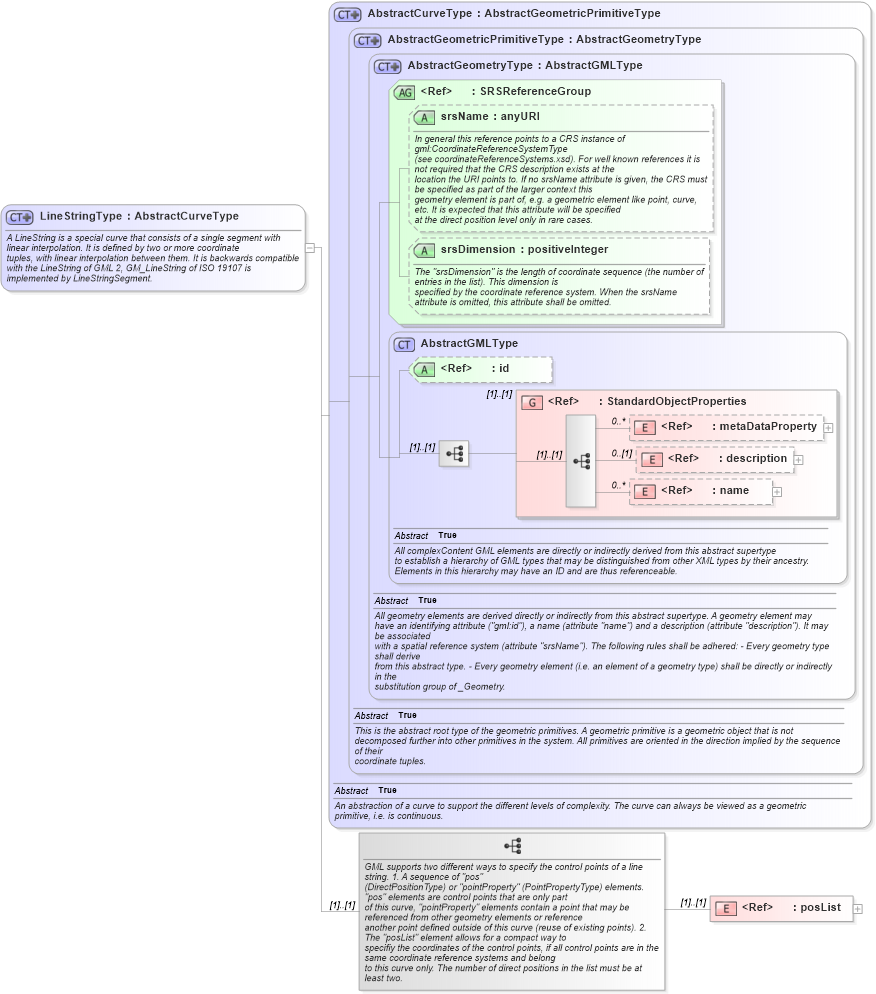
A LineString is a special curve that consists of a single segment with linear interpolation. It is defined by two or more coordinate tuples, with linear interpolation between them. It is backwards compatible with the LineString of GML 2, GM_LineString of ISO 19107 is implemented by LineStringSegment.
Collapse XSD Schema Diagram:
Drilldown into posList in schema gml_xsd Drilldown into name in schema gml_xsd Drilldown into description in schema gml_xsd Drilldown into metaDataProperty in schema gml_xsd Drilldown into StandardObjectProperties in schema gml_xsd Drilldown into id in schema gml_xsd Drilldown into AbstractGMLType in schema gml_xsd Drilldown into srsDimension in schema gml_xsd Drilldown into srsName in schema gml_xsd Drilldown into SRSReferenceGroup in schema gml_xsd Drilldown into AbstractGeometryType in schema gml_xsd Drilldown into AbstractGeometricPrimitiveType in schema gml_xsd Drilldown into AbstractCurveType in schema gml_xsdXSD Diagram of LineStringType in schema gml_xsd (National Information Exchange Model (NEIM))
Collapse XSD Schema Code:
<complexType name="LineStringType">
    <annotation>
        <appinfo source="urn:opengis:specification:gml:schema-xsd:geometryBasic0d1d:v3.1.1">geometryBasic0d1d.xsd</appinfo>
        <documentation>A LineString is a special curve that consists of a single segment with linear interpolation. It is defined by two or more coordinate 
			tuples, with linear interpolation between them. It is backwards compatible with the LineString of GML 2, GM_LineString of ISO 19107 is 
			implemented by LineStringSegment.</documentation>
    </annotation>
    <complexContent>
        <extension base="gml:AbstractCurveType">
            <sequence>
                <annotation>
                    <documentation>GML supports two different ways to specify the control points of a line string. 1. A sequence of "pos" 
							(DirectPositionType) or "pointProperty" (PointPropertyType) elements. "pos" elements are control points that are only part 
							of this curve, "pointProperty" elements contain a point that may be referenced from other geometry elements or reference 
							another point defined outside of this curve (reuse of existing points). 2. The "posList" element allows for a compact way to 
							specifiy the coordinates of the control points, if all control points are in the same coordinate reference systems and belong 
							to this curve only. The number of direct positions in the list must be at least two.</documentation>
                </annotation>
                <element ref="gml:posList" />
            </sequence>
        </extension>
    </complexContent>
</complexType>
Collapse Child Elements:
Name Type Min Occurs Max Occurs
metaDataProperty gml:metaDataProperty 0 unbounded
description gml:description 0 (1)
name gml:name 0 unbounded
posList gml:posList (1) (1)
<xs:group> gml:StandardObjectProperties (1) (1)
Collapse Child Attributes:
Name Type Default Value Use
id gml:id Optional
srsName gml:srsName Optional
srsDimension gml:srsDimension Optional
Collapse Derivation Tree:
Collapse References:
gml:LineString