Definition Type: SimpleType
Name: Separator_type
Namespace: http://niem.gov/niem/external/urisa-street-address/draft-0.2.0/dhs-gmo/1.0.0
Containing Schema: StreetAddressDataStandard.xsd
Documentation:
A symbol or word required as a separator between components of a complex element or class. The separator is required for address number ranges and for intersection addresses, and it is occasionally needed in constructing complete street numbers. 1. The default separator, an empty space, is implicit and is not shown in the syntaxes of complex elements and classes. 2. An explicit separator is required for address ranges and intersection addresses. 3. Within a given dataset, one value should be used consistently within a given complex element. 4. For complete street numbers, the separator is rarely needed and its use should be minimized. As an alternative, the separator symbol usually can be included with the address number prefix or suffix. 5. The separator is not needed in creating fractions (1/2, etc.) for address number suffixes. 6. Some address parsing softaware permits the use of ampersands to signify intersection addresses. Be wary, though--in many programming languages, ampersands are reserved for other uses, which could complicate data exchange.
Collapse XSD Schema Diagram:
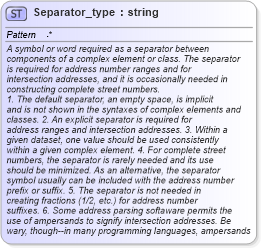
XSD Diagram of Separator_type in schema streetaddressdatastandard_xsd (National Information Exchange Model (NEIM))
Collapse XSD Schema Code:
<xsd:simpleType name="Separator_type">
    <xsd:annotation>
        <xsd:documentation xml:lang="en">
A symbol or word required as a separator between
components of a complex element or class. The separator
is required for address number ranges and for
intersection addresses, and it is occasionally needed in
constructing complete street numbers.
1. The default separator, an empty space, is implicit
and is not shown in the syntaxes of complex elements and
classes. 2. An explicit separator is required for
address ranges and intersection addresses. 3. Within a
given dataset, one value should be used consistently
within a given complex element. 4. For complete street
numbers, the separator is rarely needed and its use
should be minimized. As an alternative, the separator
symbol usually can be included with the address number
prefix or suffix. 5. The separator is not needed in
creating fractions (1/2, etc.) for address number
suffixes. 6. Some address parsing softaware permits the
use of ampersands to signify intersection addresses. Be
wary, though--in many programming languages, ampersands
are reserved for other uses, which could complicate data
exchange.
</xsd:documentation>
    </xsd:annotation>
    <xsd:restriction base="xsd:string">
        <xsd:pattern value=".*" />
    </xsd:restriction>
</xsd:simpleType>
Collapse Facets:
Facet Value
Pattern .*
Collapse Derivation Tree:
Collapse References:
addr:Separator, addr:Separator