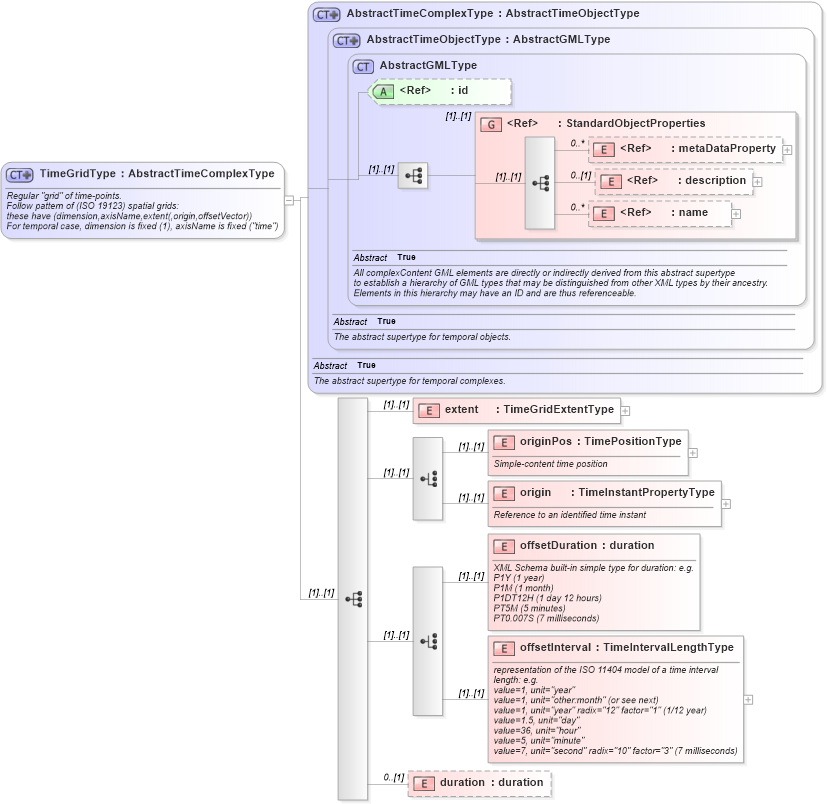
<complexType name="TimeGridType">
    <annotation>
        <documentation>Regular "grid" of time-points.
Follow pattern of (ISO 19123) spatial grids:
these have (dimension,axisName,extent(,origin,offsetVector))
For temporal case, dimension is fixed (1), axisName is fixed ("time")</documentation>
    </annotation>
    <complexContent>
        <extension base="gml:AbstractTimeComplexType">
            <sequence>
                <element name="extent" type="swe:TimeGridExtentType" />
                <choice>
                    <element name="originPos" type="gml:TimePositionType">
                        <annotation>
                            <documentation>Simple-content time position</documentation>
                        </annotation>
                    </element>
                    <element name="origin" type="gml:TimeInstantPropertyType">
                        <annotation>
                            <documentation>Reference to an identified time instant</documentation>
                        </annotation>
                    </element>
                </choice>
                <choice>
                    <element name="offsetDuration" type="duration">
                        <annotation>
                            <documentation>XML Schema built-in simple type for duration: e.g.
P1Y (1 year)
P1M (1 month)
P1DT12H (1 day 12 hours)
PT5M (5 minutes)
PT0.007S (7 milliseconds)</documentation>
                        </annotation>
                    </element>
                    <element name="offsetInterval" type="gml:TimeIntervalLengthType">
                        <annotation>
                            <documentation>representation of the ISO 11404 model of a time interval
length: e.g.
value=1, unit="year"
value=1, unit="other:month" (or see next)
value=1, unit="year" radix="12" factor="1" (1/12 year)
value=1.5, unit="day"
value=36, unit="hour"
value=5, unit="minute"
value=7, unit="second" radix="10" factor="3" (7 milliseconds)</documentation>
                        </annotation>
                    </element>
                </choice>
                <element name="duration" type="duration" minOccurs="0" />
            </sequence>
        </extension>
    </complexContent>
</complexType>
|
 XSD Schema Diagram: