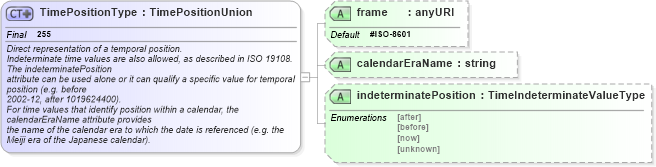
<complexType name="TimePositionType" final="#all">
    <annotation>
        <appinfo source="urn:opengis:specification:gml:schema-xsd:temporal:3.1.1">temporal.xsd</appinfo>
        <documentation xml:lang="en">Direct representation of a temporal position.
      Indeterminate time values are also allowed, as described in ISO 19108. The indeterminatePosition
      attribute can be used alone or it can qualify a specific value for temporal position (e.g. before
      2002-12, after 1019624400).
      For time values that identify position within a calendar, the calendarEraName attribute provides
      the name of the calendar era to which the date is referenced (e.g. the Meiji era of the Japanese calendar).
      </documentation>
    </annotation>
    <simpleContent>
        <extension base="gml:TimePositionUnion">
            <attribute name="frame" type="anyURI" use="optional" default="#ISO-8601" />
            <attribute name="calendarEraName" type="string" use="optional" />
            <attribute name="indeterminatePosition" type="gml:TimeIndeterminateValueType" use="optional" />
        </extension>
    </simpleContent>
</complexType>
|
 XSD Schema Diagram: