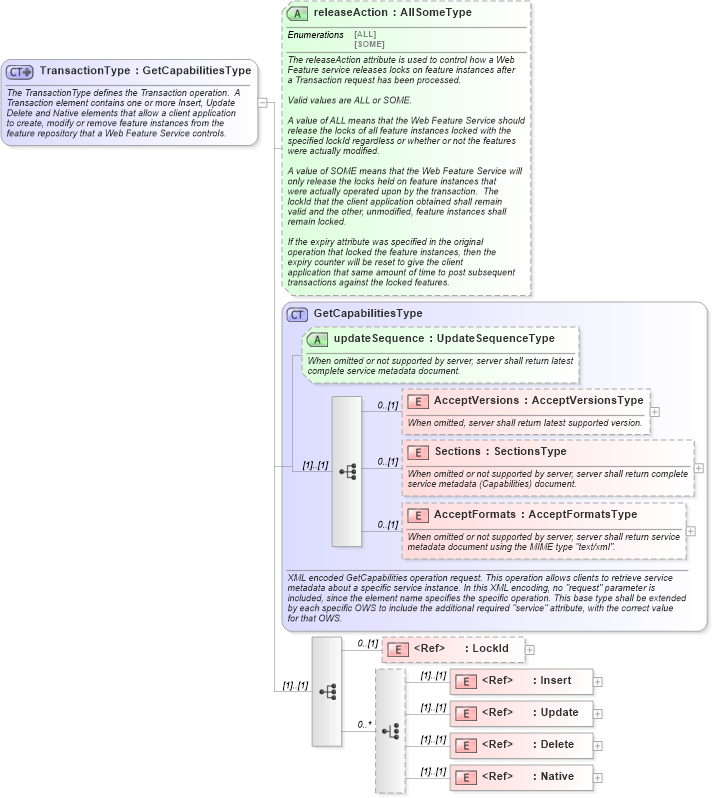
<xsd:complexType name="TransactionType">
    <xsd:annotation>
        <xsd:documentation>
            The TransactionType defines the Transaction operation.  A
            Transaction element contains one or more Insert, Update
            Delete and Native elements that allow a client application
            to create, modify or remove feature instances from the
            feature repository that a Web Feature Service controls.
         </xsd:documentation>
    </xsd:annotation>
    <xsd:complexContent>
        <xsd:extension base="ows:GetCapabilitiesType">
            <xsd:sequence>
                <xsd:element ref="wfs:LockId" minOccurs="0">
                    <xsd:annotation>
                        <xsd:documentation>
                        In order for a client application to operate upon
                        locked feature instances, the Transaction request
                        must include the LockId element.  The content of
                        this element must be the lock identifier the client
                        application obtained from a previous
                        GetFeatureWithLock or LockFeature operation.

                        If the correct lock identifier is specified the Web
                        Feature Service knows that the client application may
                        operate upon the locked feature instances.

                        No LockId element needs to be specified to operate upon
                        unlocked features.
                     </xsd:documentation>
                    </xsd:annotation>
                </xsd:element>
                <xsd:choice minOccurs="0" maxOccurs="unbounded">
                    <xsd:element ref="wfs:Insert" />
                    <xsd:element ref="wfs:Update" />
                    <xsd:element ref="wfs:Delete" />
                    <xsd:element ref="wfs:Native" />
                </xsd:choice>
            </xsd:sequence>
            <xsd:attribute name="releaseAction" type="wfs:AllSomeType" use="optional">
                <xsd:annotation>
                    <xsd:documentation>
                     The releaseAction attribute is used to control how a Web
                     Feature service releases locks on feature instances after
                     a Transaction request has been processed.

                     Valid values are ALL or SOME.

                     A value of ALL means that the Web Feature Service should
                     release the locks of all feature instances locked with the
                     specified lockId regardless or whether or not the features
                     were actually modified.

                     A value of SOME means that the Web Feature Service will
                     only release the locks held on feature instances that
                     were actually operated upon by the transaction.  The
                     lockId that the client application obtained shall remain
                     valid and the other, unmodified, feature instances shall
                     remain locked.

                     If the expiry attribute was specified in the original
                     operation that locked the feature instances, then the
                     expiry counter will be reset to give the client
                     application that same amount of time to post subsequent
                     transactions against the locked features.
                  </xsd:documentation>
                </xsd:annotation>
            </xsd:attribute>
        </xsd:extension>
    </xsd:complexContent>
</xsd:complexType>
|
 XSD Schema Diagram: