Definition Type: AttributeGroup
Name: localid
Containing Schema: NewsML_1.2.xsd
Documentation:
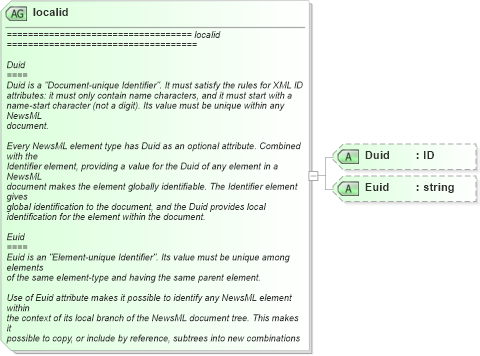
=================================== localid ==================================== Duid ==== Duid is a "Document-unique Identifier". It must satisfy the rules for XML ID attributes: it must only contain name characters, and it must start with a name-start character (not a digit). Its value must be unique within any NewsML document. Every NewsML element type has Duid as an optional attribute. Combined with the Identifier element, providing a value for the Duid of any element in a NewsML document makes the element globally identifiable. The Identifier element gives global identification to the document, and the Duid provides local identification for the element within the document. Euid ==== Euid is an "Element-unique Identifier". Its value must be unique among elements of the same element-type and having the same parent element. Use of Euid attribute makes it possible to identify any NewsML element within the context of its local branch of the NewsML document tree. This makes it possible to copy, or include by reference, subtrees into new combinations in ways that would break the uniqueness of Duids (thereby forcing new Duids to be allocated), but still being able to retain the identity of each element. If Euids are maintained at every level, it is possible to identify, for example "The ContentItem whose Euid is abc within the NewsComponent whose Euid is def". Such identification patterns would be preserved even after "pruning and grafting" of subtrees. ================================================================================ ===================================== data ===================================== Where data is included, it may be directly in the form of a DataContent element, or in the form of DataContent wrapped in an Encoding element, or by reference through an Href attribute. In the latter case an empty Encoding element may be present. ================================================================================
Collapse XSD Schema Diagram:
Drilldown into Euid in schema newsml_1_2_xsd Drilldown into Duid in schema newsml_1_2_xsdXSD Diagram of localid in schema newsml_1_2_xsd (News Markup Language (NewsML))
Collapse XSD Schema Code:
<xs:attributeGroup name="localid">
    <xs:annotation>
        <xs:documentation> 
=================================== localid ====================================

Duid
====
Duid is a "Document-unique Identifier". It must satisfy the rules for XML ID
attributes: it must only contain name characters, and it must start with a 
name-start character (not a digit). Its value must be unique within any NewsML
document.

Every NewsML element type has Duid as an optional attribute. Combined with the
Identifier element, providing a value for the Duid of any element in a NewsML
document makes the element globally identifiable. The Identifier element gives
global identification to the document, and the Duid provides local
identification for the element within the document.

Euid
====
Euid is an "Element-unique Identifier". Its value must be unique among elements
of the same element-type and having the same parent element.

Use of Euid attribute makes it possible to identify any NewsML element within
the context of its local branch of the NewsML document tree. This makes it
possible to copy, or include by reference, subtrees into new combinations in
ways that would break the uniqueness of Duids (thereby forcing new Duids to be
allocated), but still being able to retain the identity of each element. If
Euids are maintained at every level, it is possible to identify, for example
"The ContentItem whose Euid is abc within the NewsComponent whose Euid is def".
Such identification patterns would be preserved even after "pruning and
grafting" of subtrees.
================================================================================

      					
 ===================================== data =====================================
Where data is included, it may be directly in the form of a DataContent element,
or in the form of DataContent wrapped in an Encoding element, or by reference
through an Href attribute. In the latter case an empty Encoding element may be present.
================================================================================
		</xs:documentation>
    </xs:annotation>
    <xs:attribute name="Duid" type="xs:ID" />
    <xs:attribute name="Euid" type="xs:string" />
</xs:attributeGroup>
Collapse Child Attributes:
Name Type Default Value Use
Duid Duid (Optional)
Euid Euid (Optional)