Definition Type: Element
Name: SyncProductionSchedule
Namespace: http://www.openapplications.org/oagis/9
Type: nsA:SyncProductionScheduleType
Containing Schema: SyncProductionSchedule.xsd
Abstract
Documentation:
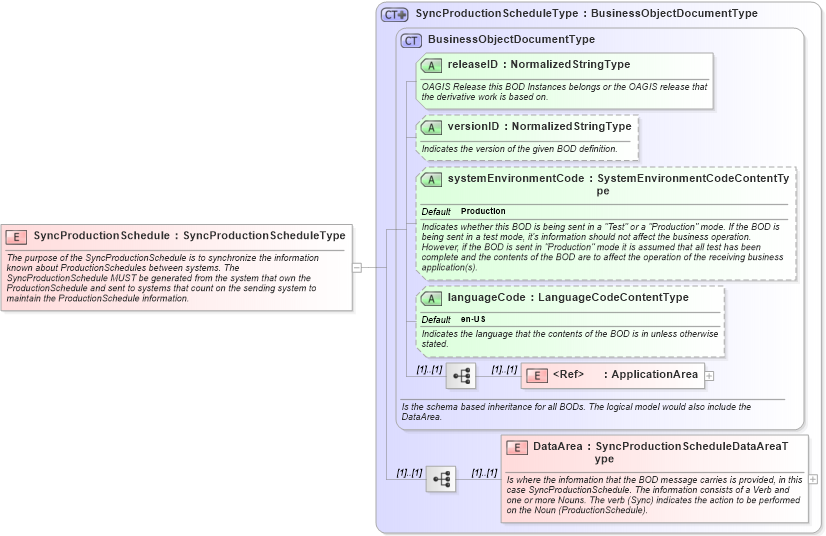
The purpose of the SyncProductionSchedule is to synchronize the information known about ProductionSchedules between systems. The SyncProductionSchedule MUST be generated from the system that own the ProductionSchedule and sent to systems that count on the sending system to maintain the ProductionSchedule information.
Collapse XSD Schema Diagram:
Drilldown into DataArea in schema syncproductionschedule_xsd Drilldown into ApplicationArea in schema meta_xsd Drilldown into languageCode in schema meta_xsd Drilldown into systemEnvironmentCode in schema meta_xsd Drilldown into versionID in schema meta_xsd Drilldown into releaseID in schema meta_xsd Drilldown into BusinessObjectDocumentType in schema meta_xsd Drilldown into SyncProductionScheduleType in schema syncproductionschedule_xsdXSD Diagram of SyncProductionSchedule in schema syncproductionschedule_xsd (Open Applications Group (OAGIS))
Collapse XSD Schema Code:
<xsd:element name="SyncProductionSchedule" type="SyncProductionScheduleType">
    <xsd:annotation>
        <xsd:documentation source="http://www.openapplications.org/oagis/9">The purpose of the SyncProductionSchedule is to synchronize the information known about ProductionSchedules between systems. The SyncProductionSchedule MUST be generated from the system that own the ProductionSchedule and sent to systems that count on the sending system to maintain the ProductionSchedule information.
</xsd:documentation>
    </xsd:annotation>
</xsd:element>
Collapse Child Elements:
Name Type Min Occurs Max Occurs
ApplicationArea nsA:ApplicationArea (1) (1)
DataArea nsA:DataArea (1) (1)
Collapse Child Attributes:
Name Type Default Value Use
releaseID nsA:releaseID Required
versionID nsA:versionID Optional
systemEnvironmentCode nsA:systemEnvironmentCode Production Optional
languageCode nsA:languageCode en-US Optional
Collapse Derivation Tree: