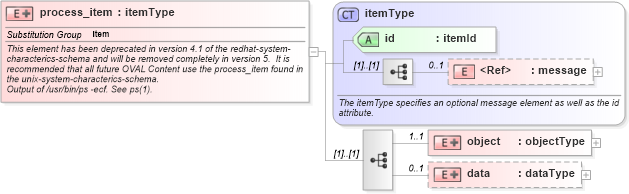
<xsd:element name="process_item" substitutionGroup="system_characteristics:item">
<xsd:annotation>
<xsd:documentation>This element has been deprecated in version 4.1 of the redhat-system-characterics-schema and will be removed completely in version 5. It is recommended that all future OVAL Content use the process_item found in the unix-system-characterics-schema.</xsd:documentation>
<xsd:documentation>Output of /usr/bin/ps -ecf. See ps(1).</xsd:documentation>
<xsd:appinfo>
<item_name>Process Item</item_name>
<extends>itemType</extends>
<valid_sections>message, object, data</valid_sections>
<example>
</example>
</xsd:appinfo>
</xsd:annotation>
<xsd:complexType>
<xsd:complexContent>
<xsd:extension base="system_characteristics:itemType">
<xsd:sequence>
<xsd:element name="object" minOccurs="1" maxOccurs="1">
<xsd:complexType>
<xsd:complexContent>
<xsd:extension base="system_characteristics:objectType">
<xsd:sequence>
<xsd:element name="command" type="system_characteristics:objectStringType" minOccurs="1" maxOccurs="1">
<xsd:annotation>
<xsd:documentation>This specifies the command/program name about which data has has been collected.</xsd:documentation>
<xsd:appinfo>
<parent_item>Process Item</parent_item>
<cardinality>1</cardinality>
<content>string</content>
</xsd:appinfo>
</xsd:annotation>
</xsd:element>
</xsd:sequence>
</xsd:extension>
</xsd:complexContent>
</xsd:complexType>
</xsd:element>
<xsd:element name="data" minOccurs="0" maxOccurs="1">
<xsd:complexType>
<xsd:complexContent>
<xsd:extension base="system_characteristics:dataType">
<xsd:sequence>
<xsd:element name="exec_time" type="system_characteristics:dataStringType" minOccurs="1" maxOccurs="1">
<xsd:annotation>
<xsd:documentation>This is the amount of CPU time (not clock time) that the process has consumed, formatted in HH:MM:SS or days.</xsd:documentation>
<xsd:appinfo>
<parent_item>Process Item</parent_item>
<cardinality>1</cardinality>
<content>string</content>
<valid_datatypes>string</valid_datatypes>
</xsd:appinfo>
</xsd:annotation>
</xsd:element>
<xsd:element name="pid" type="system_characteristics:dataIntType" minOccurs="1" maxOccurs="1">
<xsd:annotation>
<xsd:documentation>This is the process ID of the process.</xsd:documentation>
<xsd:appinfo>
<parent_item>Process Item</parent_item>
<cardinality>1</cardinality>
<content>integer</content>
<valid_datatypes>integer</valid_datatypes>
</xsd:appinfo>
</xsd:annotation>
</xsd:element>
<xsd:element name="ppid" type="system_characteristics:dataIntType" minOccurs="1" maxOccurs="1">
<xsd:annotation>
<xsd:documentation>This is the process ID of the process's parent process.</xsd:documentation>
<xsd:appinfo>
<parent_item>Process Item</parent_item>
<cardinality>1</cardinality>
<content>integer</content>
<valid_datatypes>integer</valid_datatypes>
</xsd:appinfo>
</xsd:annotation>
</xsd:element>
<xsd:element name="priority" type="system_characteristics:dataStringType" minOccurs="1" maxOccurs="1">
<xsd:annotation>
<xsd:documentation>This is the scheduling priority with which the process runs. This can be adjusted with the nice command or nice() system call.</xsd:documentation>
<xsd:appinfo>
<parent_item>Process Item</parent_item>
<cardinality>1</cardinality>
<content>string</content>
<valid_datatypes>string</valid_datatypes>
</xsd:appinfo>
</xsd:annotation>
</xsd:element>
<xsd:element name="scheduling_class" type="system_characteristics:dataStringType" minOccurs="1" maxOccurs="1">
<xsd:annotation>
<xsd:documentation>A characteristic maintained by the scheduler: RT (real-time), TS (timeshare), B (batch), BC (batch critical), WL (weightless) and GN (gang scheduled).</xsd:documentation>
<xsd:appinfo>
<parent_item>Process Item</parent_item>
<cardinality>1</cardinality>
<content>string</content>
<valid_datatypes>string</valid_datatypes>
</xsd:appinfo>
</xsd:annotation>
</xsd:element>
<xsd:element name="start_time" type="system_characteristics:dataStringType" minOccurs="1" maxOccurs="1">
<xsd:annotation>
<xsd:documentation>This is the time of day in which the process was started in either HH:MM:SS or days.</xsd:documentation>
<xsd:appinfo>
<parent_item>Process Item</parent_item>
<cardinality>1</cardinality>
<content>string</content>
<valid_datatypes>string</valid_datatypes>
</xsd:appinfo>
</xsd:annotation>
</xsd:element>
<xsd:element name="tty" type="system_characteristics:dataStringType" minOccurs="1" maxOccurs="1">
<xsd:annotation>
<xsd:documentation>This is the TTY on which the process was started, if applicable.</xsd:documentation>
<xsd:appinfo>
<parent_item>Process Item</parent_item>
<cardinality>1</cardinality>
<content>string</content>
<valid_datatypes>string</valid_datatypes>
</xsd:appinfo>
</xsd:annotation>
</xsd:element>
<xsd:element name="user_id" type="system_characteristics:dataStringType" minOccurs="1" maxOccurs="1">
<xsd:annotation>
<xsd:documentation>The numeric user id, or uid, is the third column of each user's entry in /etc/passwd. It represents the owner, and thus privilege level, of the specified program.</xsd:documentation>
<xsd:appinfo>
<parent_item>Process Item</parent_item>
<cardinality>1</cardinality>
<content>string</content>
<valid_datatypes>string</valid_datatypes>
</xsd:appinfo>
</xsd:annotation>
</xsd:element>
</xsd:sequence>
</xsd:extension>
</xsd:complexContent>
</xsd:complexType>
</xsd:element>
</xsd:sequence>
</xsd:extension>
</xsd:complexContent>
</xsd:complexType>
</xsd:element>
|
 XSD Schema Diagram: