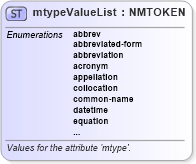
<xsd:simpleType name="mtypeValueList">
    <xsd:annotation>
        <xsd:documentation>Values for the attribute 'mtype'.</xsd:documentation>
    </xsd:annotation>
    <xsd:restriction base="xsd:NMTOKEN">
        <xsd:enumeration value="abbrev">
            <xsd:annotation>
                <xsd:documentation>Indicates the marked text is an abbreviation.</xsd:documentation>
            </xsd:annotation>
        </xsd:enumeration>
        <xsd:enumeration value="abbreviated-form">
            <xsd:annotation>
                <xsd:documentation>ISO-12620 2.1.8: A term resulting from the omission of any part of the full term while designating the same concept.</xsd:documentation>
            </xsd:annotation>
        </xsd:enumeration>
        <xsd:enumeration value="abbreviation">
            <xsd:annotation>
                <xsd:documentation>ISO-12620 2.1.8.1: An abbreviated form of a simple term resulting from the omission of some of its letters (e.g. 'adj.' for 'adjective').</xsd:documentation>
            </xsd:annotation>
        </xsd:enumeration>
        <xsd:enumeration value="acronym">
            <xsd:annotation>
                <xsd:documentation>ISO-12620 2.1.8.4: An abbreviated form of a term made up of letters from the full form of a multiword term strung together into a sequence pronounced only syllabically (e.g. 'radar' for 'radio detecting and ranging').</xsd:documentation>
            </xsd:annotation>
        </xsd:enumeration>
        <xsd:enumeration value="appellation">
            <xsd:annotation>
                <xsd:documentation>ISO-12620: A proper-name term, such as the name of an agency or other proper entity.</xsd:documentation>
            </xsd:annotation>
        </xsd:enumeration>
        <xsd:enumeration value="collocation">
            <xsd:annotation>
                <xsd:documentation>ISO-12620 2.1.18.1: A recurrent word combination characterized by cohesion in that the components of the collocation must co-occur within an utterance or series of utterances, even though they do not necessarily have to maintain immediate proximity to one another.</xsd:documentation>
            </xsd:annotation>
        </xsd:enumeration>
        <xsd:enumeration value="common-name">
            <xsd:annotation>
                <xsd:documentation>ISO-12620 2.1.5: A synonym for an international scientific term that is used in general discourse in a given language.</xsd:documentation>
            </xsd:annotation>
        </xsd:enumeration>
        <xsd:enumeration value="datetime">
            <xsd:annotation>
                <xsd:documentation>Indicates the marked text is a date and/or time.</xsd:documentation>
            </xsd:annotation>
        </xsd:enumeration>
        <xsd:enumeration value="equation">
            <xsd:annotation>
                <xsd:documentation>ISO-12620 2.1.15: An expression used to represent a concept based on a statement that two mathematical expressions are, for instance, equal as identified by the equal sign (=), or assigned to one another by a similar sign.</xsd:documentation>
            </xsd:annotation>
        </xsd:enumeration>
        <xsd:enumeration value="expanded-form">
            <xsd:annotation>
                <xsd:documentation>ISO-12620 2.1.7: The complete representation of a term for which there is an abbreviated form.</xsd:documentation>
            </xsd:annotation>
        </xsd:enumeration>
        <xsd:enumeration value="formula">
            <xsd:annotation>
                <xsd:documentation>ISO-12620 2.1.14: Figures, symbols or the like used to express a concept briefly, such as a mathematical or chemical formula.</xsd:documentation>
            </xsd:annotation>
        </xsd:enumeration>
        <xsd:enumeration value="head-term">
            <xsd:annotation>
                <xsd:documentation>ISO-12620 2.1.1: The concept designation that has been chosen to head a terminological record.</xsd:documentation>
            </xsd:annotation>
        </xsd:enumeration>
        <xsd:enumeration value="initialism">
            <xsd:annotation>
                <xsd:documentation>ISO-12620 2.1.8.3: An abbreviated form of a term consisting of some of the initial letters of the words making up a multiword term or the term elements making up a compound term when these letters are pronounced individually (e.g. 'BSE' for 'bovine spongiform encephalopathy').</xsd:documentation>
            </xsd:annotation>
        </xsd:enumeration>
        <xsd:enumeration value="international-scientific-term">
            <xsd:annotation>
                <xsd:documentation>ISO-12620 2.1.4: A term that is part of an international scientific nomenclature as adopted by an appropriate scientific body.</xsd:documentation>
            </xsd:annotation>
        </xsd:enumeration>
        <xsd:enumeration value="internationalism">
            <xsd:annotation>
                <xsd:documentation>ISO-12620 2.1.6: A term that has the same or nearly identical orthographic or phonemic form in many languages.</xsd:documentation>
            </xsd:annotation>
        </xsd:enumeration>
        <xsd:enumeration value="logical-expression">
            <xsd:annotation>
                <xsd:documentation>ISO-12620 2.1.16: An expression used to represent a concept based on mathematical or logical relations, such as statements of inequality, set relationships, Boolean operations, and the like.</xsd:documentation>
            </xsd:annotation>
        </xsd:enumeration>
        <xsd:enumeration value="materials-management-unit">
            <xsd:annotation>
                <xsd:documentation>ISO-12620 2.1.17: A unit to track object.</xsd:documentation>
            </xsd:annotation>
        </xsd:enumeration>
        <xsd:enumeration value="name">
            <xsd:annotation>
                <xsd:documentation>Indicates the marked text is a name.</xsd:documentation>
            </xsd:annotation>
        </xsd:enumeration>
        <xsd:enumeration value="near-synonym">
            <xsd:annotation>
                <xsd:documentation>ISO-12620 2.1.3: A term that represents the same or a very similar concept as another term in the same language, but for which interchangeability is limited to some contexts and inapplicable in others.</xsd:documentation>
            </xsd:annotation>
        </xsd:enumeration>
        <xsd:enumeration value="part-number">
            <xsd:annotation>
                <xsd:documentation>ISO-12620 2.1.17.2: A unique alphanumeric designation assigned to an object in a manufacturing system.</xsd:documentation>
            </xsd:annotation>
        </xsd:enumeration>
        <xsd:enumeration value="phrase">
            <xsd:annotation>
                <xsd:documentation>Indicates the marked text is a phrase.</xsd:documentation>
            </xsd:annotation>
        </xsd:enumeration>
        <xsd:enumeration value="phraseological-unit">
            <xsd:annotation>
                <xsd:documentation>ISO-12620 2.1.18: Any group of two or more words that form a unit, the meaning of which frequently cannot be deduced based on the combined sense of the words making up the phrase.</xsd:documentation>
            </xsd:annotation>
        </xsd:enumeration>
        <xsd:enumeration value="protected">
            <xsd:annotation>
                <xsd:documentation>Indicates the marked text should not be translated.</xsd:documentation>
            </xsd:annotation>
        </xsd:enumeration>
        <xsd:enumeration value="romanized-form">
            <xsd:annotation>
                <xsd:documentation>ISO-12620 2.1.12: A form of a term resulting from an operation whereby non-Latin writing systems are converted to the Latin alphabet.</xsd:documentation>
            </xsd:annotation>
        </xsd:enumeration>
        <xsd:enumeration value="seg">
            <xsd:annotation>
                <xsd:documentation>Indicates that the marked text represents a segment.</xsd:documentation>
            </xsd:annotation>
        </xsd:enumeration>
        <xsd:enumeration value="set-phrase">
            <xsd:annotation>
                <xsd:documentation>ISO-12620 2.1.18.2: A fixed, lexicalized phrase.</xsd:documentation>
            </xsd:annotation>
        </xsd:enumeration>
        <xsd:enumeration value="short-form">
            <xsd:annotation>
                <xsd:documentation>ISO-12620 2.1.8.2: A variant of a multiword term that includes fewer words than the full form of the term (e.g. 'Group of Twenty-four' for 'Intergovernmental Group of Twenty-four on International Monetary Affairs').</xsd:documentation>
            </xsd:annotation>
        </xsd:enumeration>
        <xsd:enumeration value="sku">
            <xsd:annotation>
                <xsd:documentation>ISO-12620 2.1.17.1: Stock keeping unit, an inventory item identified by a unique alphanumeric designation assigned to an object in an inventory control system.</xsd:documentation>
            </xsd:annotation>
        </xsd:enumeration>
        <xsd:enumeration value="standard-text">
            <xsd:annotation>
                <xsd:documentation>ISO-12620 2.1.19: A fixed chunk of recurring text.</xsd:documentation>
            </xsd:annotation>
        </xsd:enumeration>
        <xsd:enumeration value="symbol">
            <xsd:annotation>
                <xsd:documentation>ISO-12620 2.1.13: A designation of a concept by letters, numerals, pictograms or any combination thereof.</xsd:documentation>
            </xsd:annotation>
        </xsd:enumeration>
        <xsd:enumeration value="synonym">
            <xsd:annotation>
                <xsd:documentation>ISO-12620 2.1.2: Any term that represents the same or a very similar concept as the main entry term in a term entry.</xsd:documentation>
            </xsd:annotation>
        </xsd:enumeration>
        <xsd:enumeration value="synonymous-phrase">
            <xsd:annotation>
                <xsd:documentation>ISO-12620 2.1.18.3: Phraseological unit in a language that expresses the same semantic content as another phrase in that same language.</xsd:documentation>
            </xsd:annotation>
        </xsd:enumeration>
        <xsd:enumeration value="term">
            <xsd:annotation>
                <xsd:documentation>Indicates the marked text is a term.</xsd:documentation>
            </xsd:annotation>
        </xsd:enumeration>
        <xsd:enumeration value="transcribed-form">
            <xsd:annotation>
                <xsd:documentation>ISO-12620 2.1.11: A form of a term resulting from an operation whereby the characters of one writing system are represented by characters from another writing system, taking into account the pronunciation of the characters converted.</xsd:documentation>
            </xsd:annotation>
        </xsd:enumeration>
        <xsd:enumeration value="transliterated-form">
            <xsd:annotation>
                <xsd:documentation>ISO-12620 2.1.10: A form of a term resulting from an operation whereby the characters of an alphabetic writing system are represented by characters from another alphabetic writing system.</xsd:documentation>
            </xsd:annotation>
        </xsd:enumeration>
        <xsd:enumeration value="truncated-term">
            <xsd:annotation>
                <xsd:documentation>ISO-12620 2.1.8.5: An abbreviated form of a term resulting from the omission of one or more term elements or syllables (e.g. 'flu' for 'influenza').</xsd:documentation>
            </xsd:annotation>
        </xsd:enumeration>
        <xsd:enumeration value="variant">
            <xsd:annotation>
                <xsd:documentation>ISO-12620 2.1.9: One of the alternate forms of a term.</xsd:documentation>
            </xsd:annotation>
        </xsd:enumeration>
    </xsd:restriction>
</xsd:simpleType>
|
 XSD Schema Diagram:
 Facets: