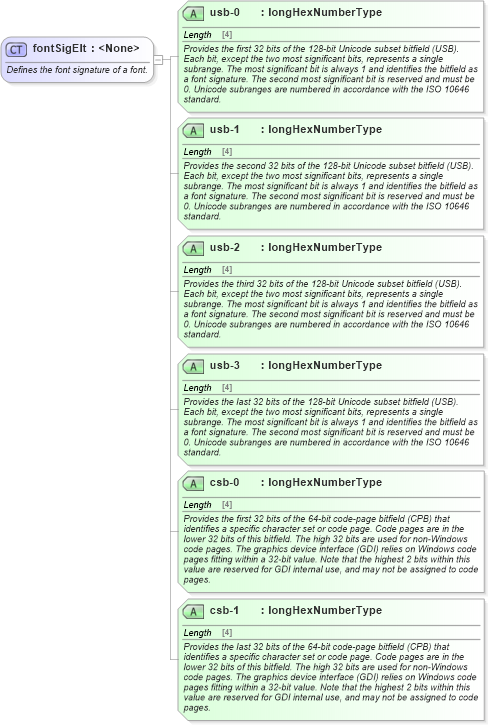
<xsd:complexType name="fontSigElt">
    <xsd:annotation>
        <xsd:documentation>Defines the font signature of a font.</xsd:documentation>
    </xsd:annotation>
    <xsd:attribute name="usb-0" use="required" type="longHexNumberType">
        <xsd:annotation>
            <xsd:documentation>Provides the first 32 bits of the 128-bit Unicode subset bitfield (USB). Each bit, except the two most significant bits, represents a single subrange. The most significant bit is always 1 and identifies the bitfield as a font signature. The second most significant bit is reserved and must be 0. Unicode subranges are numbered in accordance with the ISO 10646 standard.</xsd:documentation>
        </xsd:annotation>
    </xsd:attribute>
    <xsd:attribute name="usb-1" use="required" type="longHexNumberType">
        <xsd:annotation>
            <xsd:documentation>Provides the second 32 bits of the 128-bit Unicode subset bitfield (USB). Each bit, except the two most significant bits, represents a single subrange. The most significant bit is always 1 and identifies the bitfield as a font signature. The second most significant bit is reserved and must be 0. Unicode subranges are numbered in accordance with the ISO 10646 standard.</xsd:documentation>
        </xsd:annotation>
    </xsd:attribute>
    <xsd:attribute name="usb-2" use="required" type="longHexNumberType">
        <xsd:annotation>
            <xsd:documentation>Provides the third 32 bits of the 128-bit Unicode subset bitfield (USB). Each bit, except the two most significant bits, represents a single subrange. The most significant bit is always 1 and identifies the bitfield as a font signature. The second most significant bit is reserved and must be 0. Unicode subranges are numbered in accordance with the ISO 10646 standard.</xsd:documentation>
        </xsd:annotation>
    </xsd:attribute>
    <xsd:attribute name="usb-3" use="required" type="longHexNumberType">
        <xsd:annotation>
            <xsd:documentation>Provides the last 32 bits of the 128-bit Unicode subset bitfield (USB). Each bit, except the two most significant bits, represents a single subrange. The most significant bit is always 1 and identifies the bitfield as a font signature. The second most significant bit is reserved and must be 0. Unicode subranges are numbered in accordance with the ISO 10646 standard.</xsd:documentation>
        </xsd:annotation>
    </xsd:attribute>
    <xsd:attribute name="csb-0" use="required" type="longHexNumberType">
        <xsd:annotation>
            <xsd:documentation>Provides the first 32 bits of the 64-bit code-page bitfield (CPB) that identifies a specific character set or code page. Code pages are in the lower 32 bits of this bitfield. The high 32 bits are used for non-Windows code pages. The graphics device interface (GDI) relies on Windows code pages fitting within a 32-bit value. Note that the highest 2 bits within this value are reserved for GDI internal use, and may not be assigned to code pages.</xsd:documentation>
        </xsd:annotation>
    </xsd:attribute>
    <xsd:attribute name="csb-1" use="required" type="longHexNumberType">
        <xsd:annotation>
            <xsd:documentation>Provides the last 32 bits of the 64-bit code-page bitfield (CPB) that identifies a specific character set or code page. Code pages are in the lower 32 bits of this bitfield. The high 32 bits are used for non-Windows code pages. The graphics device interface (GDI) relies on Windows code pages fitting within a 32-bit value. Note that the highest 2 bits within this value are reserved for GDI internal use, and may not be assigned to code pages.</xsd:documentation>
        </xsd:annotation>
    </xsd:attribute>
</xsd:complexType>
|
 XSD Schema Diagram: