<xs:complexType name="FlightSegmentType">
    <xs:annotation>
        <xs:documentation xml:lang="en">
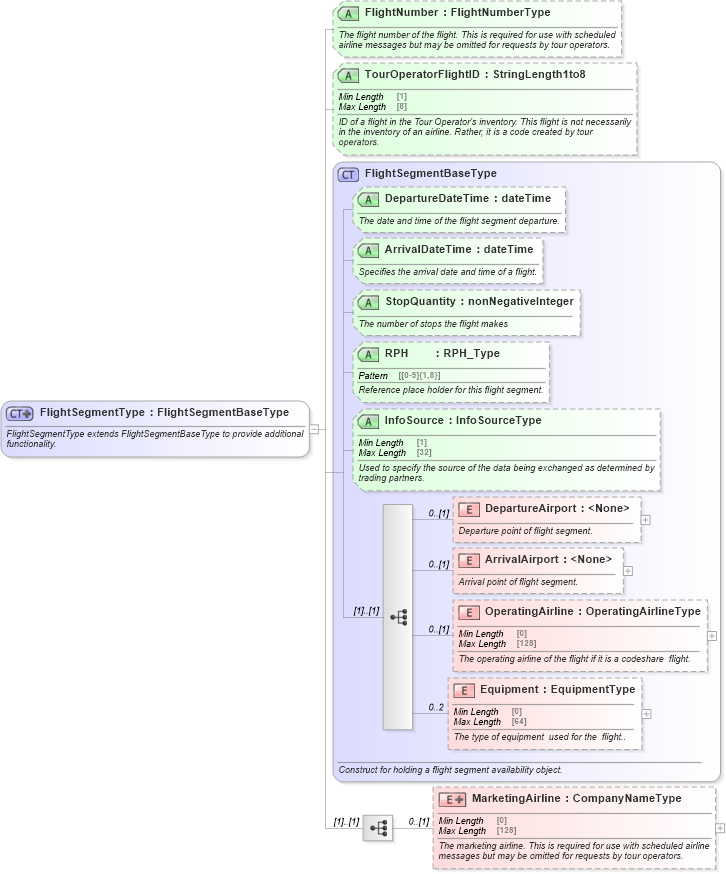
	FlightSegmentType extends FlightSegmentBaseType to provide additional functionality.
	</xs:documentation>
    </xs:annotation>
    <xs:complexContent>
        <xs:extension base="FlightSegmentBaseType">
            <xs:sequence>
                <xs:element name="MarketingAirline" minOccurs="0">
                    <xs:annotation>
                        <xs:documentation xml:lang="en">The marketing airline. This is required for use with scheduled airline messages but may be omitted for requests by tour operators. </xs:documentation>
                    </xs:annotation>
                    <xs:complexType>
                        <xs:simpleContent>
                            <xs:extension base="CompanyNameType">
                                <xs:attributeGroup ref="SingleVendorIndGroup">
                                    <xs:annotation>
                                        <xs:documentation xml:lang="en">To specifiy if an airline is a member of an alliance.</xs:documentation>
                                    </xs:annotation>
                                </xs:attributeGroup>
                            </xs:extension>
                        </xs:simpleContent>
                    </xs:complexType>
                </xs:element>
            </xs:sequence>
            <xs:attribute name="FlightNumber" type="FlightNumberType" use="optional">
                <xs:annotation>
                    <xs:documentation xml:lang="en">The flight number of the flight. This is required for use with scheduled airline messages but may be omitted for requests by tour operators. </xs:documentation>
                </xs:annotation>
            </xs:attribute>
            <xs:attribute name="TourOperatorFlightID" type="StringLength1to8" use="optional">
                <xs:annotation>
                    <xs:documentation xml:lang="en">ID of a flight in the Tour Operator's inventory. This flight is not necessarily in the inventory of an airline. Rather, it is a code created by tour operators.  </xs:documentation>
                </xs:annotation>
            </xs:attribute>
        </xs:extension>
    </xs:complexContent>
</xs:complexType>
|
 XSD Schema Diagram: