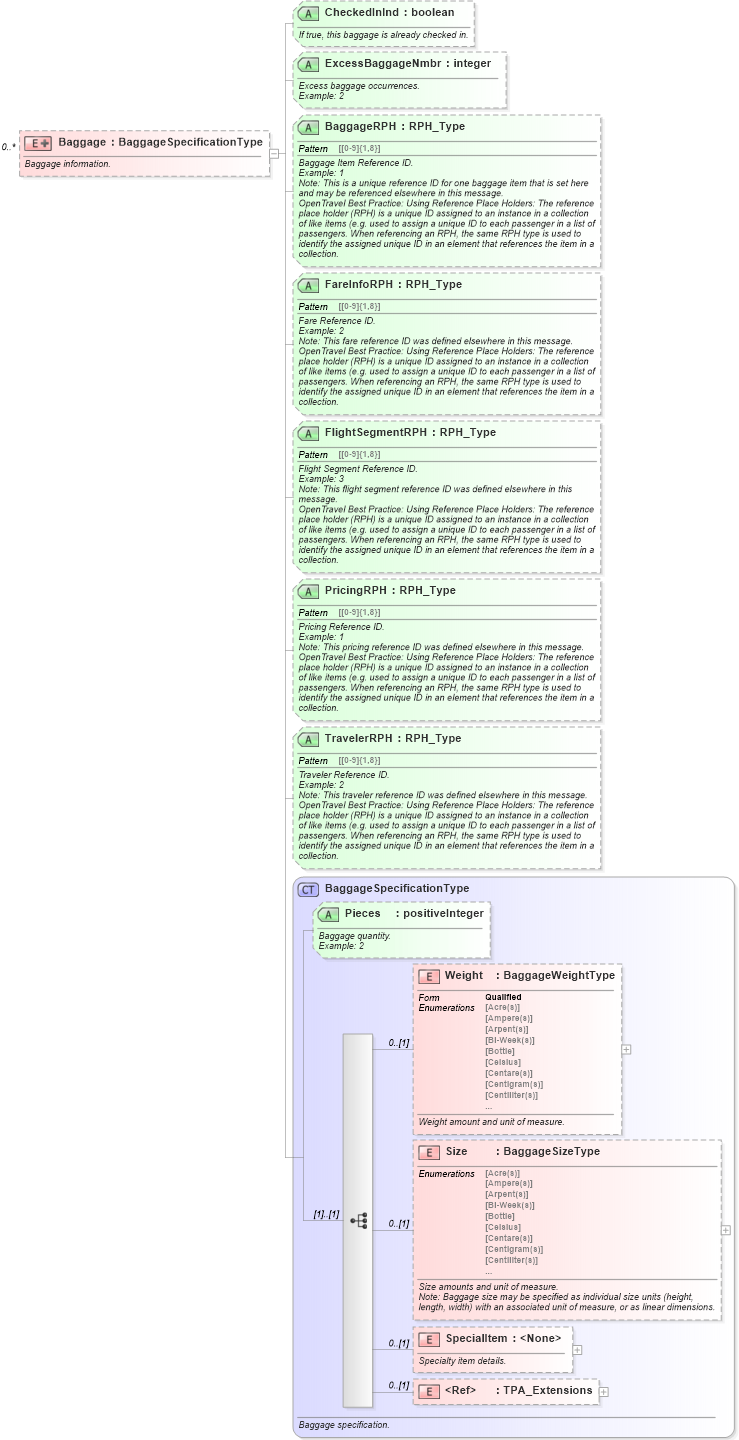
<xs:element name="Baggage" minOccurs="0" maxOccurs="unbounded">
    <xs:annotation>
        <xs:documentation source="Description" xml:lang="en">Baggage information.</xs:documentation>
    </xs:annotation>
    <xs:complexType>
        <xs:complexContent>
            <xs:extension base="BaggageSpecificationType">
                <xs:attribute name="CheckedInInd" type="xs:boolean" use="optional">
                    <xs:annotation>
                        <xs:documentation source="Description" xml:lang="en">If true, this baggage is already checked in.</xs:documentation>
                    </xs:annotation>
                </xs:attribute>
                <xs:attribute name="ExcessBaggageNmbr" type="xs:integer" use="optional">
                    <xs:annotation>
                        <xs:documentation source="Description" xml:lang="en">Excess baggage occurrences.</xs:documentation>
                        <xs:documentation source="Example" xml:lang="en">Example: 2</xs:documentation>
                    </xs:annotation>
                </xs:attribute>
                <xs:attribute name="BaggageRPH" type="RPH_Type" use="optional">
                    <xs:annotation>
                        <xs:documentation source="Description" xml:lang="en">Baggage Item Reference ID.</xs:documentation>
                        <xs:documentation source="Example" xml:lang="en">Example: 1</xs:documentation>
                        <xs:documentation source="Moreinfo" xml:lang="en">Note: This is a unique reference ID for one baggage item that is set here and may be referenced elsewhere in this message.</xs:documentation>
                        <xs:documentation source="Moreinfo" xml:lang="en">OpenTravel Best Practice: Using Reference Place Holders: The reference place holder (RPH) is a unique ID assigned to an instance in a collection of like items (e.g. used to assign a unique ID to each passenger in a list of passengers. When referencing an RPH, the same RPH type is used to identify the assigned unique ID in an element that references the item in a collection.</xs:documentation>
                    </xs:annotation>
                </xs:attribute>
                <xs:attribute name="FareInfoRPH" type="RPH_Type" use="optional">
                    <xs:annotation>
                        <xs:documentation source="Description" xml:lang="en">Fare Reference ID.</xs:documentation>
                        <xs:documentation source="Example" xml:lang="en">Example: 2</xs:documentation>
                        <xs:documentation source="Moreinfo" xml:lang="en">Note: This fare reference ID was defined elsewhere in this message.</xs:documentation>
                        <xs:documentation source="Moreinfo" xml:lang="en">OpenTravel Best Practice: Using Reference Place Holders: The reference place holder (RPH) is a unique ID assigned to an instance in a collection of like items (e.g. used to assign a unique ID to each passenger in a list of passengers. When referencing an RPH, the same RPH type is used to identify the assigned unique ID in an element that references the item in a collection.</xs:documentation>
                    </xs:annotation>
                </xs:attribute>
                <xs:attribute name="FlightSegmentRPH" type="RPH_Type" use="optional">
                    <xs:annotation>
                        <xs:documentation source="Description" xml:lang="en">Flight Segment Reference ID.</xs:documentation>
                        <xs:documentation source="Example" xml:lang="en">Example: 3</xs:documentation>
                        <xs:documentation source="Moreinfo" xml:lang="en">Note: This flight segment reference ID was defined elsewhere in this message.</xs:documentation>
                        <xs:documentation source="Moreinfo" xml:lang="en">OpenTravel Best Practice: Using Reference Place Holders: The reference place holder (RPH) is a unique ID assigned to an instance in a collection of like items (e.g. used to assign a unique ID to each passenger in a list of passengers. When referencing an RPH, the same RPH type is used to identify the assigned unique ID in an element that references the item in a collection.</xs:documentation>
                    </xs:annotation>
                </xs:attribute>
                <xs:attribute name="PricingRPH" type="RPH_Type" use="optional">
                    <xs:annotation>
                        <xs:documentation source="Description" xml:lang="en">Pricing Reference ID.</xs:documentation>
                        <xs:documentation source="Example" xml:lang="en">Example: 1</xs:documentation>
                        <xs:documentation source="Moreinfo" xml:lang="en">Note: This pricing reference ID was defined elsewhere in this message.</xs:documentation>
                        <xs:documentation source="Moreinfo" xml:lang="en">OpenTravel Best Practice: Using Reference Place Holders: The reference place holder (RPH) is a unique ID assigned to an instance in a collection of like items (e.g. used to assign a unique ID to each passenger in a list of passengers. When referencing an RPH, the same RPH type is used to identify the assigned unique ID in an element that references the item in a collection.</xs:documentation>
                    </xs:annotation>
                </xs:attribute>
                <xs:attribute name="TravelerRPH" type="RPH_Type" use="optional">
                    <xs:annotation>
                        <xs:documentation source="Description" xml:lang="en">Traveler Reference ID.</xs:documentation>
                        <xs:documentation source="Example" xml:lang="en">Example: 2</xs:documentation>
                        <xs:documentation source="Moreinfo" xml:lang="en">Note: This traveler reference ID was defined elsewhere in this message.</xs:documentation>
                        <xs:documentation source="Moreinfo" xml:lang="en">OpenTravel Best Practice: Using Reference Place Holders: The reference place holder (RPH) is a unique ID assigned to an instance in a collection of like items (e.g. used to assign a unique ID to each passenger in a list of passengers. When referencing an RPH, the same RPH type is used to identify the assigned unique ID in an element that references the item in a collection.</xs:documentation>
                    </xs:annotation>
                </xs:attribute>
            </xs:extension>
        </xs:complexContent>
    </xs:complexType>
</xs:element>
|
 XSD Schema Diagram: