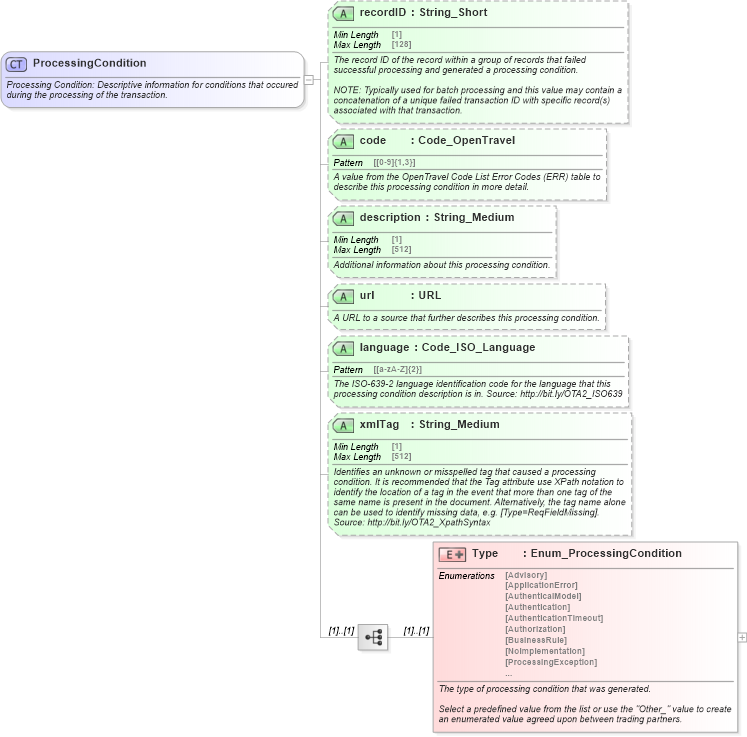
<xsd:complexType name="ProcessingCondition">
    <xsd:annotation>
        <xsd:documentation xml:lang="en">Processing Condition: Descriptive information for conditions that occured during the processing of the transaction.</xsd:documentation>
    </xsd:annotation>
    <xsd:sequence>
        <xsd:element name="Type">
            <xsd:annotation>
                <xsd:documentation xml:lang="en">The type of processing condition that was generated.

Select a predefined value from the list or use the "Other_" value to create an enumerated value agreed upon between trading partners.</xsd:documentation>
            </xsd:annotation>
            <xsd:complexType>
                <xsd:simpleContent>
                    <xsd:extension base="Enum_ProcessingCondition">
                        <xsd:attribute name="extension" type="ota:String_EnumExtension" use="optional">
                            <xsd:annotation>
                                <xsd:documentation xml:lang="en">A string value that represents an "Other_", or extended, enumerated value agreed upon between trading partners.

NOTE: It is recommended that you submit an OpenTravel comment to formally add any extended enumerations to the OpenTravel Specification to maximize trading partner interoperability.</xsd:documentation>
                            </xsd:annotation>
                        </xsd:attribute>
                    </xsd:extension>
                </xsd:simpleContent>
            </xsd:complexType>
        </xsd:element>
    </xsd:sequence>
    <xsd:attribute name="recordID" type="String_Short" use="optional">
        <xsd:annotation>
            <xsd:documentation xml:lang="en">The record ID of the record within a group of records that failed successful processing and generated a processing condition.

NOTE: Typically used for batch processing and this value may contain a concatenation of a unique failed transaction ID with specific record(s) associated with that transaction.</xsd:documentation>
        </xsd:annotation>
    </xsd:attribute>
    <xsd:attribute name="code" type="Code_OpenTravel" use="optional">
        <xsd:annotation>
            <xsd:documentation xml:lang="en">A value from the OpenTravel Code List Error Codes (ERR) table to describe this processing condition in more detail.</xsd:documentation>
        </xsd:annotation>
    </xsd:attribute>
    <xsd:attribute name="description" type="String_Medium" use="optional">
        <xsd:annotation>
            <xsd:documentation xml:lang="en">Additional information about this processing condition.</xsd:documentation>
        </xsd:annotation>
    </xsd:attribute>
    <xsd:attribute name="url" type="URL" use="optional">
        <xsd:annotation>
            <xsd:documentation xml:lang="en">A URL to a source that further describes this processing condition.</xsd:documentation>
        </xsd:annotation>
    </xsd:attribute>
    <xsd:attribute name="language" type="Code_ISO_Language" use="optional">
        <xsd:annotation>
            <xsd:documentation xml:lang="en">The ISO-639-2 language identification code for the language that this processing condition description is in. Source: http://bit.ly/OTA2_ISO639</xsd:documentation>
        </xsd:annotation>
    </xsd:attribute>
    <xsd:attribute name="xmlTag" type="String_Medium" use="optional">
        <xsd:annotation>
            <xsd:documentation xml:lang="en">Identifies an unknown or misspelled tag that caused a processing condition. It is recommended that the Tag attribute use XPath notation to identify the location of a tag in the event that more than one tag of the same name is present in the document. Alternatively, the tag name alone can be used to identify missing data, e.g. [Type=ReqFieldMissing].
Source: http://bit.ly/OTA2_XpathSyntax</xsd:documentation>
        </xsd:annotation>
    </xsd:attribute>
</xsd:complexType>
|
 XSD Schema Diagram: