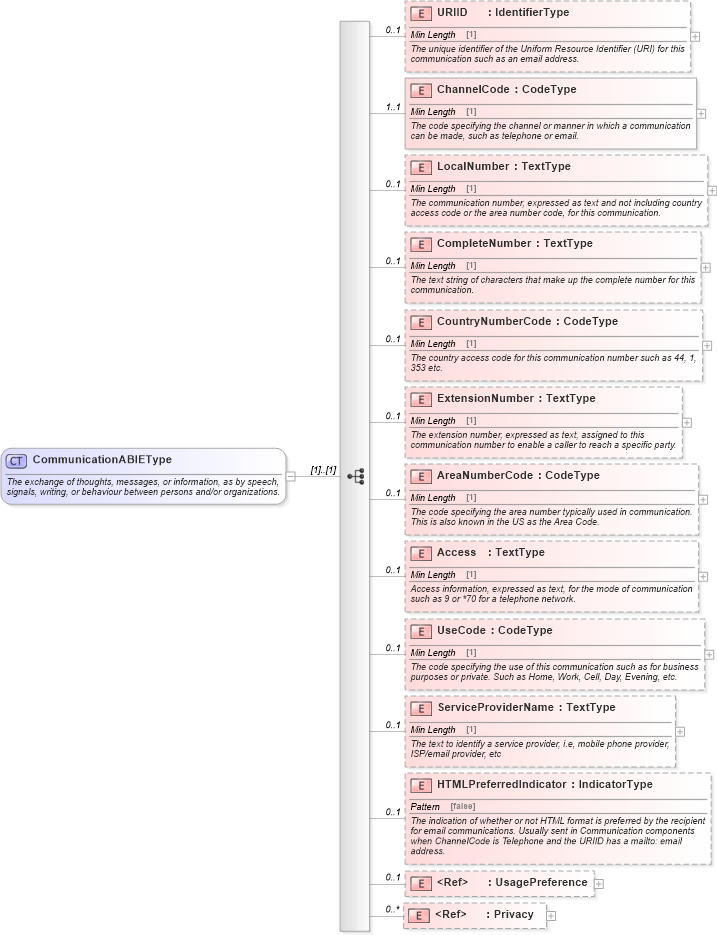
<xsd:complexType name="CommunicationABIEType">
    <xsd:annotation>
        <xsd:documentation>The exchange of thoughts, messages, or information, as by speech, signals, writing, or behaviour between persons and/or organizations.</xsd:documentation>
    </xsd:annotation>
    <xsd:sequence>
        <xsd:element maxOccurs="1" minOccurs="0" name="URIID" type="udt:IdentifierType">
            <xsd:annotation>
                <xsd:documentation source="http://www.starstandard.org/STAR/5">The unique identifier of the Uniform Resource Identifier (URI) for this communication such as an email address.</xsd:documentation>
            </xsd:annotation>
        </xsd:element>
        <xsd:element maxOccurs="1" minOccurs="1" name="ChannelCode" type="udt:CodeType">
            <xsd:annotation>
                <xsd:documentation source="http://www.starstandard.org/STAR/5">The code specifying the channel or manner in which a communication can be made, such as telephone or email.</xsd:documentation>
            </xsd:annotation>
        </xsd:element>
        <xsd:element maxOccurs="1" minOccurs="0" name="LocalNumber" type="udt:TextType">
            <xsd:annotation>
                <xsd:documentation source="http://www.starstandard.org/STAR/5">The communication number, expressed as text and not including country access code or the area number code, for this communication.</xsd:documentation>
            </xsd:annotation>
        </xsd:element>
        <xsd:element maxOccurs="1" minOccurs="0" name="CompleteNumber" type="udt:TextType">
            <xsd:annotation>
                <xsd:documentation source="http://www.starstandard.org/STAR/5">The text string of characters that make up the complete number for this communication.</xsd:documentation>
            </xsd:annotation>
        </xsd:element>
        <xsd:element maxOccurs="1" minOccurs="0" name="CountryNumberCode" type="udt:CodeType">
            <xsd:annotation>
                <xsd:documentation source="http://www.starstandard.org/STAR/5">The country access code for this communication number such as 44, 1, 353 etc.</xsd:documentation>
            </xsd:annotation>
        </xsd:element>
        <xsd:element maxOccurs="1" minOccurs="0" name="ExtensionNumber" type="udt:TextType">
            <xsd:annotation>
                <xsd:documentation source="http://www.starstandard.org/STAR/5">The extension number, expressed as text, assigned to this communication number to enable a caller to reach a specific party.</xsd:documentation>
            </xsd:annotation>
        </xsd:element>
        <xsd:element maxOccurs="1" minOccurs="0" name="AreaNumberCode" type="udt:CodeType">
            <xsd:annotation>
                <xsd:documentation source="http://www.starstandard.org/STAR/5">The code specifying the area number typically used in communication. This is also known in the US as the Area Code.</xsd:documentation>
            </xsd:annotation>
        </xsd:element>
        <xsd:element maxOccurs="1" minOccurs="0" name="Access" type="udt:TextType">
            <xsd:annotation>
                <xsd:documentation source="http://www.starstandard.org/STAR/5">Access information, expressed as text, for the mode of communication such as 9 or *70 for a telephone network.</xsd:documentation>
            </xsd:annotation>
        </xsd:element>
        <xsd:element maxOccurs="1" minOccurs="0" name="UseCode" type="udt:CodeType">
            <xsd:annotation>
                <xsd:documentation source="http://www.starstandard.org/STAR/5">The code specifying the use of this communication such as for business purposes or private. Such as Home, Work, Cell, Day, Evening, etc.</xsd:documentation>
            </xsd:annotation>
        </xsd:element>
        <xsd:element maxOccurs="1" minOccurs="0" name="ServiceProviderName" type="udt:TextType">
            <xsd:annotation>
                <xsd:documentation source="http://www.starstandard.org/STAR/5">The text to identify a service provider, i.e, mobile phone provider, ISP/email provider, etc</xsd:documentation>
            </xsd:annotation>
        </xsd:element>
        <xsd:element maxOccurs="1" minOccurs="0" name="HTMLPreferredIndicator" type="udt:IndicatorType">
            <xsd:annotation>
                <xsd:documentation source="http://www.starstandard.org/STAR/5">The indication of whether or not HTML format is preferred by the recipient for email communications. Usually sent in Communication components when ChannelCode is Telephone and the URIID has a mailto: email address.</xsd:documentation>
            </xsd:annotation>
        </xsd:element>
        <xsd:element maxOccurs="1" minOccurs="0" ref="UsagePreference">
            <xsd:annotation>
                <xsd:documentation>The preference for the usage of this communication method.</xsd:documentation>
            </xsd:annotation>
        </xsd:element>
        <xsd:element maxOccurs="unbounded" minOccurs="0" ref="Privacy">
            <xsd:annotation>
                <xsd:documentation source="http://www.starstandard.org/STAR/5">This is used to indicate the various privacy types for this communication. If appearing within a Party component, then this option overrides the Privacy types specified at the Party component for this communication.</xsd:documentation>
            </xsd:annotation>
        </xsd:element>
    </xsd:sequence>
</xsd:complexType>
|
 XSD Schema Diagram: