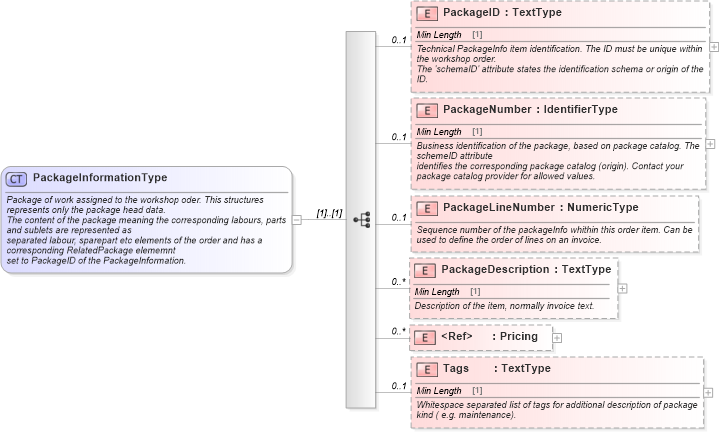
<xsd:complexType name="PackageInformationType">
    <xsd:annotation xmlns="http://www.starstandards.org/STAR">
        <xsd:documentation source="http://www.starstandard.org/STAR/5">
                Package of work assigned to the workshop oder. This structures represents only the package head data.
                The content of the package meaning the corresponding labours, parts and sublets are represented as
                separated labour, sparepart etc elements of the order and has a corresponding RelatedPackage elememnt
                set to PackageID of the PackageInformation.
            </xsd:documentation>
    </xsd:annotation>
    <xsd:sequence>
        <xsd:element name="PackageID" type="udt:TextType" minOccurs="0" maxOccurs="1">
            <xsd:annotation xmlns:udt="http://www.openapplications.org/oagis/9/unqualifieddatatypes/1.1" xmlns:qdt="http://www.openapplications.org/oagis/9/qualifieddatatypes/1.1">
                <xsd:documentation source="http://www.starstandard.org/STAR/5">
                        Technical PackageInfo item identification. The ID must be unique within the workshop order.
                        The 'schemaID' attribute states the identification schema or origin of the ID.
                    </xsd:documentation>
            </xsd:annotation>
        </xsd:element>
        <xsd:element name="PackageNumber" type="udt:IdentifierType" minOccurs="0" maxOccurs="1">
            <xsd:annotation xmlns:udt="http://www.openapplications.org/oagis/9/unqualifieddatatypes/1.1" xmlns:qdt="http://www.openapplications.org/oagis/9/qualifieddatatypes/1.1">
                <xsd:documentation source="http://www.starstandard.org/STAR/5">
                        Business identification of the package, based on package catalog. The schemeID attribute
                        identifies the corresponding package catalog (origin). Contact your package catalog provider for allowed values.
                    </xsd:documentation>
            </xsd:annotation>
        </xsd:element>
        <xsd:element name="PackageLineNumber" type="udt:NumericType" minOccurs="0" maxOccurs="1">
            <xsd:annotation xmlns:udt="http://www.openapplications.org/oagis/9/unqualifieddatatypes/1.1" xmlns:qdt="http://www.openapplications.org/oagis/9/qualifieddatatypes/1.1">
                <xsd:documentation source="http://www.starstandard.org/STAR/5">
                        Sequence number of the packageInfo whithin this order item. Can be used to define the order of lines on an invoice.
                    </xsd:documentation>
            </xsd:annotation>
        </xsd:element>
        <xsd:element name="PackageDescription" type="udt:TextType" minOccurs="0" maxOccurs="unbounded">
            <xsd:annotation xmlns:udt="http://www.openapplications.org/oagis/9/unqualifieddatatypes/1.1" xmlns:qdt="http://www.openapplications.org/oagis/9/qualifieddatatypes/1.1">
                <xsd:documentation source="http://www.starstandard.org/STAR/5">
                        Description of the item, normally invoice text.
                    </xsd:documentation>
            </xsd:annotation>
        </xsd:element>
        <xsd:element ref="Pricing" minOccurs="0" maxOccurs="unbounded">
        </xsd:element>
        <xsd:element name="Tags" type="udt:TextType" minOccurs="0" maxOccurs="1">
            <xsd:annotation xmlns:udt="http://www.openapplications.org/oagis/9/unqualifieddatatypes/1.1" xmlns:qdt="http://www.openapplications.org/oagis/9/qualifieddatatypes/1.1">
                <xsd:documentation source="http://www.starstandard.org/STAR/5">
                        Whitespace separated list of tags for additional description of package kind ( e.g. maintenance).
                    </xsd:documentation>
            </xsd:annotation>
        </xsd:element>
    </xsd:sequence>
</xsd:complexType>
|
 XSD Schema Diagram: