<xsd:simpleType name="ComputerStorageUnitsContentType">
    <xsd:annotation>
        <xsd:documentation>
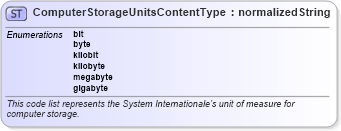
                This code list represents the System Internationale's unit of measure for computer storage.
            </xsd:documentation>
    </xsd:annotation>
    <xsd:restriction base="xsd:normalizedString">
        <xsd:enumeration value="bit">
            <xsd:annotation>
                <xsd:documentation source="http://www.unc.edu/~rowlett/units/">
                        The basic unit of the amount of data. Each bit records one of the two possible answers to a single question: "0" or "1," "yes" or "no," "on" or "off."
                    </xsd:documentation>
            </xsd:annotation>
        </xsd:enumeration>
        <xsd:enumeration value="byte">
            <xsd:annotation>
                <xsd:documentation>
                        A unit of information used in computer engineering. Technically the byte is a unit of addressable memory, and its size can vary depending on the machine or the computing language. However, in most contexts the byte is equal to 8 bits.
                    </xsd:documentation>
            </xsd:annotation>
        </xsd:enumeration>
        <xsd:enumeration value="kilobit">
            <xsd:annotation>
                <xsd:documentation source="http://www.unc.edu/~rowlett/units/">A unit of information equal to 1000 bits, or, in some cases, equal to 1024 bits or 128 bytes. The larger unit is now supposed to be called a kibibit.</xsd:documentation>
            </xsd:annotation>
        </xsd:enumeration>
        <xsd:enumeration value="kilobyte">
            <xsd:annotation>
                <xsd:documentation source="http://www.unc.edu/~rowlett/units/">A unit of information equal to 1000 bytes. As a unit of computer storage, however, the kilobyte is usually equal to 1024 bytes, although this should now be called a kibibyte.</xsd:documentation>
            </xsd:annotation>
        </xsd:enumeration>
        <xsd:enumeration value="megabyte">
            <xsd:annotation>
                <xsd:documentation source="http://www.unc.edu/~rowlett/units/">A unit of information equal to 1 000 000 bytes, but sometimes it means 1 048 576 bytes</xsd:documentation>
            </xsd:annotation>
        </xsd:enumeration>
        <xsd:enumeration value="gigabyte">
            <xsd:annotation>
                <xsd:documentation source="http://www.unc.edu/~rowlett/units/">A unit of information equal to 1 000 000 000 bytes, but sometimes it means 1 073 741 824 bytes.</xsd:documentation>
            </xsd:annotation>
        </xsd:enumeration>
    </xsd:restriction>
</xsd:simpleType>
|
 XSD Schema Diagram:
 Facets: