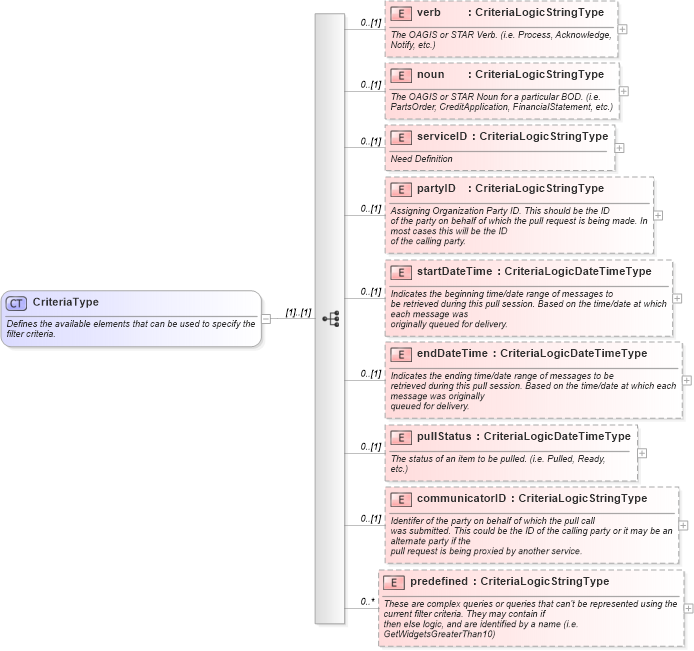
<xsd:complexType name="CriteriaType">
    <xsd:annotation>
        <xsd:documentation source="http://www.starstandard.org">
                Defines the available elements that can be used to specify the
                filter criteria.
        </xsd:documentation>
    </xsd:annotation>
    <xsd:sequence>
        <!-- Add an attribute for Not as an indicator (true/false). -->
        <xsd:element minOccurs="0" name="verb" type="CriteriaLogicStringType">
            <xsd:annotation>
                <xsd:documentation source="http://www.starstandard.org">
                        The OAGIS or STAR Verb. (i.e. Process, Acknowledge,
                        Notify, etc.)
            </xsd:documentation>
            </xsd:annotation>
        </xsd:element>
        <xsd:element minOccurs="0" name="noun" type="CriteriaLogicStringType">
            <xsd:annotation>
                <xsd:documentation source="http://www.starstandard.org">
                        The OAGIS or STAR Noun for a particular BOD. (i.e.
                        PartsOrder, CreditApplication, FinancialStatement, etc.)
                    </xsd:documentation>
            </xsd:annotation>
        </xsd:element>
        <xsd:element minOccurs="0" name="serviceID" type="CriteriaLogicStringType">
            <xsd:annotation>
                <xsd:documentation source="http://www.starstandard.org">
                        Need Definition
                    </xsd:documentation>
            </xsd:annotation>
        </xsd:element>
        <xsd:element minOccurs="0" name="partyID" type="CriteriaLogicStringType">
            <xsd:annotation>
                <xsd:documentation source="http://www.starstandard.org">
                        Assigning Organization Party ID. This should be the ID
                        of the party on behalf of which the pull request is being made. In
                        most cases this will be the ID
                        of the calling party.
                    </xsd:documentation>
            </xsd:annotation>
        </xsd:element>
        <xsd:element minOccurs="0" name="startDateTime" type="CriteriaLogicDateTimeType">
            <xsd:annotation>
                <xsd:documentation source="http://www.starstandard.org">
                        Indicates the beginning time/date range of messages to
                        be retrieved during this pull session. Based on the time/date at which each message was
                        originally queued for delivery.
                    </xsd:documentation>
            </xsd:annotation>
        </xsd:element>
        <xsd:element minOccurs="0" name="endDateTime" type="CriteriaLogicDateTimeType">
            <xsd:annotation>
                <xsd:documentation source="http://www.starstandard.org/">
                        Indicates the ending time/date range of messages to be
                        retrieved during this pull session. Based on the time/date at which each message was originally
                        queued for delivery.
                    </xsd:documentation>
            </xsd:annotation>
        </xsd:element>
        <xsd:element minOccurs="0" name="pullStatus" type="CriteriaLogicDateTimeType">
            <xsd:annotation>
                <xsd:documentation source="http://www.starstandard.org/">
                        The status of an item to be pulled. (i.e. Pulled, Ready,
                        etc.)
                    </xsd:documentation>
            </xsd:annotation>
        </xsd:element>
        <xsd:element minOccurs="0" name="communicatorID" type="CriteriaLogicStringType">
            <xsd:annotation>
                <xsd:documentation source="http://www.starstandard.org/">
                        Identifer of the party on behalf of which the pull call
                        was submitted. This could be the ID of the calling party or it may be an alternate party if the
                        pull request is being proxied by another service.
                    </xsd:documentation>
            </xsd:annotation>
        </xsd:element>
        <xsd:element minOccurs="0" name="predefined" type="CriteriaLogicStringType" maxOccurs="unbounded">
            <xsd:annotation>
                <xsd:documentation source="http://www.starstandard.org/">
                        These are complex queries or queries that can't be represented using the current filter criteria. They may contain if
                        then else logic, and are identified by a name (i.e. GetWidgetsGreaterThan10)
                    </xsd:documentation>
            </xsd:annotation>
        </xsd:element>
    </xsd:sequence>
</xsd:complexType>
|
 XSD Schema Diagram: