Definition Type: Element
Name: Get
Namespace: http://www.openapplications.org/oagis/9
Type: oagis:GetType
Containing Schema: Meta.xsd
Abstract
Documentation:
The Get verb is to communicate to a business software component a request for an existing piece or pieces of information to be returned. The Get may be paired with most of the nouns defined in the OAGIS specification.The response to this request is the Show verb. The behavior of a BOD with a Get verb is quite predictable across the nouns it is paired with.The Get is designed to retrieval of information by using that information's primary retrieval field, or key field. The Get verb may also be used to request several documents at once. Selection Criteria:There are two types of selection capabilities for most BOD's that use the Get verb.1) The first selection capability is called Field-Based Selection. Within a Get-based Business Object Document, the first Data Type that occurs in a specific BOD structure is commonly used to provide the Field-Based Selection criteria. This is always defined within the specific BOD and is commonly the required fields for that specific Data type.The Field-Based Selection enables the requester to provide a value or values (in the case of multiple required Field Identifiers), in the required fields. Then the responding component uses those values to find and return the requested information to the originating business software component.2) The second type of selection capability for Get-based BODs is called Data Type Selection. Data Type selection enables the requester to identify which Data Types within the noun are requested to be returned in the response. The use of this capability is described for each corresponding Data Type for all BODs that use the Get verb. The Data Types are identified for retrieval within the Get instance of a BOD by including the name of the Data Type in the meta data but without any Field Identifiers or Segments identified within the Data Type. This will signify to the responding application that all of the data that corresponds to that Data Type is to be included in the response.If the Data Type is not requested, the Data Type identifier is not included in the Get request and this will signify to the responding component that the Data Type is not to be returned.
Collapse XSD Schema Diagram:
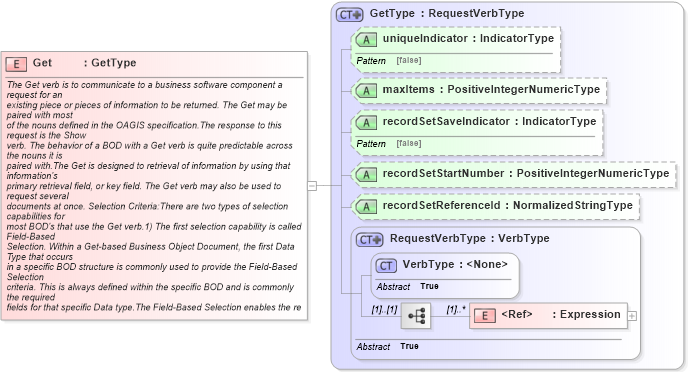
Drilldown into Expression in schema meta_xsd1 Drilldown into VerbType in schema meta_xsd1 Drilldown into RequestVerbType in schema meta_xsd1 Drilldown into recordSetReferenceId in schema meta_xsd1 Drilldown into recordSetStartNumber in schema meta_xsd1 Drilldown into recordSetSaveIndicator in schema meta_xsd1 Drilldown into maxItems in schema meta_xsd1 Drilldown into uniqueIndicator in schema meta_xsd1 Drilldown into GetType in schema meta_xsd1XSD Diagram of Get in schema meta_xsd1 (Standards for Technology in Automotive Retail)
Collapse XSD Schema Code:
<xsd:element name="Get" type="GetType">
    <xsd:annotation>
        <xsd:documentation source="http://www.openapplications.org/oagis/9.0">
            The Get verb is to communicate to a business software component a request for an
            existing piece or pieces of information to be returned. The Get may be paired with most
            of the nouns defined in the OAGIS specification.The response to this request is the Show
            verb. The behavior of a BOD with a Get verb is quite predictable across the nouns it is
            paired with.The Get is designed to retrieval of information by using that information's
            primary retrieval field, or key field. The Get verb may also be used to request several
            documents at once. Selection Criteria:There are two types of selection capabilities for
            most BOD's that use the Get verb.1) The first selection capability is called Field-Based
            Selection. Within a Get-based Business Object Document, the first Data Type that occurs
            in a specific BOD structure is commonly used to provide the Field-Based Selection
            criteria. This is always defined within the specific BOD and is commonly the required
            fields for that specific Data type.The Field-Based Selection enables the requester to
            provide a value or values (in the case of multiple required Field Identifiers), in the
            required fields. Then the responding component uses those values to find and return the
            requested information to the originating business software component.2) The second type
            of selection capability for Get-based BODs is called Data Type Selection. Data Type
            selection enables the requester to identify which Data Types within the noun are
            requested to be returned in the response. The use of this capability is described for
            each corresponding Data Type for all BODs that use the Get verb. The Data Types are
            identified for retrieval within the Get instance of a BOD by including the name of the
            Data Type in the meta data but without any Field Identifiers or Segments identified
            within the Data Type. This will signify to the responding application that all of the
            data that corresponds to that Data Type is to be included in the response.If the Data
            Type is not requested, the Data Type identifier is not included in the Get request and
            this will signify to the responding component that the Data Type is not to be returned.
         </xsd:documentation>
    </xsd:annotation>
</xsd:element>
Collapse Child Elements:
Name Type Min Occurs Max Occurs
Expression oagis:Expression (1) unbounded
Collapse Child Attributes:
Name Type Default Value Use
uniqueIndicator oagis:uniqueIndicator Optional
maxItems oagis:maxItems Optional
recordSetSaveIndicator oagis:recordSetSaveIndicator Optional
recordSetStartNumber oagis:recordSetStartNumber Optional
recordSetReferenceId oagis:recordSetReferenceId Optional
Collapse Derivation Tree: