Definition Type: Element
Name: LogicalID
Namespace: http://www.openapplications.org/oagis/9
Type: oagis:IdentifierType
Containing Schema: Meta.xsd
Abstract
Documentation:
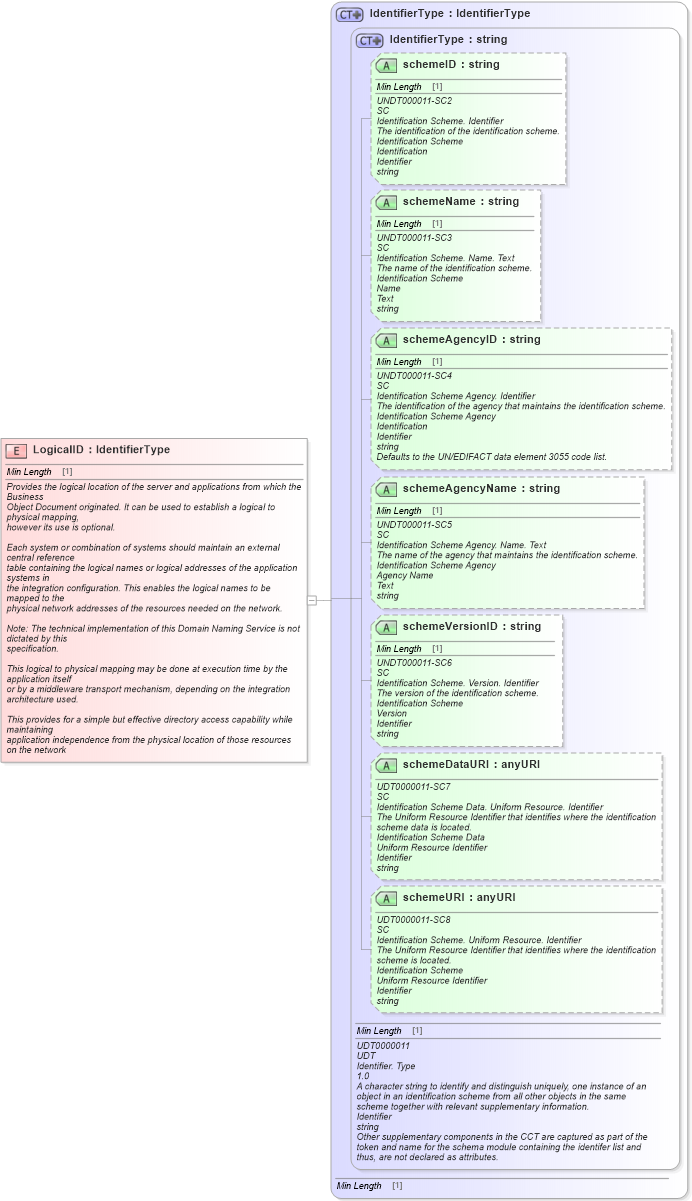
Provides the logical location of the server and applications from which the Business Object Document originated. It can be used to establish a logical to physical mapping, however its use is optional. Each system or combination of systems should maintain an external central reference table containing the logical names or logical addresses of the application systems in the integration configuration. This enables the logical names to be mapped to the physical network addresses of the resources needed on the network. Note: The technical implementation of this Domain Naming Service is not dictated by this specification. This logical to physical mapping may be done at execution time by the application itself or by a middleware transport mechanism, depending on the integration architecture used. This provides for a simple but effective directory access capability while maintaining application independence from the physical location of those resources on the network
Collapse XSD Schema Diagram:
Drilldown into schemeURI in schema unqualifieddatatypes_xsd Drilldown into schemeDataURI in schema unqualifieddatatypes_xsd Drilldown into schemeVersionID in schema unqualifieddatatypes_xsd Drilldown into schemeAgencyName in schema unqualifieddatatypes_xsd Drilldown into schemeAgencyID in schema unqualifieddatatypes_xsd Drilldown into schemeName in schema unqualifieddatatypes_xsd Drilldown into schemeID in schema unqualifieddatatypes_xsd Drilldown into IdentifierType in schema unqualifieddatatypes_xsd Drilldown into IdentifierType in schema fields_xsd1XSD Diagram of LogicalID in schema meta_xsd1 (Standards for Technology in Automotive Retail)
Collapse XSD Schema Code:
<xsd:element name="LogicalID" type="IdentifierType">
    <xsd:annotation>
        <xsd:documentation source="http://www.openapplications.org/oagis/9">
            Provides the logical location of the server and applications from which the Business
            Object Document originated. It can be used to establish a logical to physical mapping,
            however its use is optional.

            Each system or combination of systems should maintain an external central reference
            table containing the logical names or logical addresses of the application systems in
            the integration configuration. This enables the logical names to be mapped to the
            physical network addresses of the resources needed on the network.

            Note: The technical implementation of this Domain Naming Service is not dictated by this
            specification.

            This logical to physical mapping may be done at execution time by the application itself
            or by a middleware transport mechanism, depending on the integration architecture used.

            This provides for a simple but effective directory access capability while maintaining
            application independence from the physical location of those resources on the network
         </xsd:documentation>
    </xsd:annotation>
</xsd:element>
Collapse Child Attributes:
Name Type Default Value Use
schemeID udt:schemeID Optional
schemeName udt:schemeName Optional
schemeAgencyID udt:schemeAgencyID Optional
schemeAgencyName udt:schemeAgencyName Optional
schemeVersionID udt:schemeVersionID Optional
schemeDataURI udt:schemeDataURI Optional
schemeURI udt:schemeURI Optional
Collapse Derivation Tree: