Definition Type: Element
Name: Process
Namespace: http://www.openapplications.org/oagis/9
Type: oagis:ProcessType
Containing Schema: Meta.xsd
Abstract
Documentation:
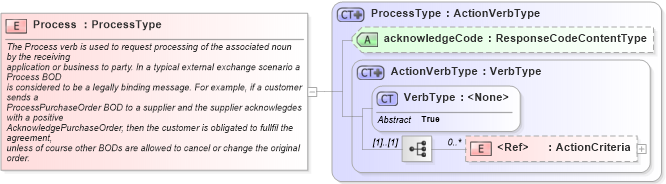
The Process verb is used to request processing of the associated noun by the receiving application or business to party. In a typical external exchange scenario a Process BOD is considered to be a legally binding message. For example, if a customer sends a ProcessPurchaseOrder BOD to a supplier and the supplier acknowlegdes with a positive AcknowledgePurchaseOrder, then the customer is obligated to fullfil the agreement, unless of course other BODs are allowed to cancel or change the original order.
Collapse XSD Schema Diagram:
Drilldown into ActionCriteria in schema meta_xsd1 Drilldown into VerbType in schema meta_xsd1 Drilldown into ActionVerbType in schema meta_xsd1 Drilldown into acknowledgeCode in schema meta_xsd1 Drilldown into ProcessType in schema meta_xsd1XSD Diagram of Process in schema meta_xsd1 (Standards for Technology in Automotive Retail)
Collapse XSD Schema Code:
<xsd:element name="Process" type="ProcessType">
    <xsd:annotation>
        <xsd:documentation source="http://www.openapplications.org/oagis/9.0">
            The Process verb is used to request processing of the associated noun by the receiving
            application or business to party. In a typical external exchange scenario a Process BOD
            is considered to be a legally binding message. For example, if a customer sends a
            ProcessPurchaseOrder BOD to a supplier and the supplier acknowlegdes with a positive
            AcknowledgePurchaseOrder, then the customer is obligated to fullfil the agreement,
            unless of course other BODs are allowed to cancel or change the original order.
         </xsd:documentation>
    </xsd:annotation>
</xsd:element>
Collapse Child Elements:
Name Type Min Occurs Max Occurs
ActionCriteria oagis:ActionCriteria 0 unbounded
Collapse Child Attributes:
Name Type Default Value Use
acknowledgeCode oagis:acknowledgeCode Optional
Collapse Derivation Tree: