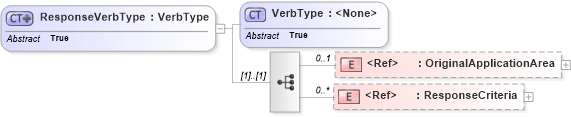
<xsd:complexType abstract="true" name="ResponseVerbType">
    <xsd:complexContent>
        <xsd:extension base="oagis:VerbType">
            <xsd:sequence>
                <xsd:element maxOccurs="1" minOccurs="0" ref="OriginalApplicationArea" />
                <xsd:element maxOccurs="unbounded" minOccurs="0" ref="oagis:ResponseCriteria">
                    <xsd:annotation>
                        <xsd:documentation> ResponseCriteria identifies the content that is returned, given a Get query
                        success or the response from the Process. In essence, the expression here has the effect of
                        filtering the part(s) of the found element(s) that are to be returned. ReturnCriteria plays no
                        role in the query itself or the process. That is handled as a match against the request BOD's
                        noun exemplar. ReturnCriteria allows the sender of the BOD to indicate which information (down
                        to the field level) is requested to be returned, given that the query has been successful in
                        matching the exemplar to existing nouns. That is, in a GetListPurchaseOrder, if one or more
                        PurchaseOrders with a TotalPrice = $1M were found, ReturnCriteria tells the BOD recipient which
                        parts of the PurchaseOrder should be populated with content when the response
                        (ShowPurchaseOrder) is formulated. The expressionLanguage indicates the expression language
                        being used. In order for the ReturnCriteria expression to be evaluable by the BOD recipient, the
                        recipient must be capable of processing and interpreting the specified expression language.
                        XPath is the default, due to its ubiquity among XML processing technologies.</xsd:documentation>
                    </xsd:annotation>
                </xsd:element>
            </xsd:sequence>
        </xsd:extension>
    </xsd:complexContent>
</xsd:complexType>
|
 XSD Schema Diagram: