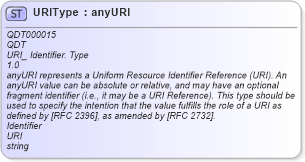
<xsd:simpleType name="URIType">
    <xsd:annotation>
        <xsd:documentation xml:lang="en">
            <ccts:UniqueID xmlns:ccts="urn:un:unece:uncefact:documentation:1.1">QDT000015</ccts:UniqueID>
            <ccts:CategoryCode xmlns:ccts="urn:un:unece:uncefact:documentation:1.1">QDT</ccts:CategoryCode>
            <ccts:DictionaryEntryName xmlns:ccts="urn:un:unece:uncefact:documentation:1.1">URI_ Identifier. Type</ccts:DictionaryEntryName>
            <ccts:VersionID xmlns:ccts="urn:un:unece:uncefact:documentation:1.1">1.0</ccts:VersionID>
            <ccts:DefinitionText xmlns:ccts="urn:un:unece:uncefact:documentation:1.1">anyURI represents a Uniform Resource Identifier Reference (URI). An anyURI value can be absolute or relative, and may have an optional fragment identifier (i.e., it may be a URI Reference). This type should be used to specify the intention that the value fulfills the role of a URI as defined by [RFC 2396], as amended by [RFC 2732].</ccts:DefinitionText>
            <ccts:RepresentationTermName xmlns:ccts="urn:un:unece:uncefact:documentation:1.1">Identifier</ccts:RepresentationTermName>
            <ccts:QualifierTerm xmlns:ccts="urn:un:unece:uncefact:documentation:1.1">URI</ccts:QualifierTerm>
            <ccts:PrimitiveType xmlns:ccts="urn:un:unece:uncefact:documentation:1.1">string</ccts:PrimitiveType>
        </xsd:documentation>
    </xsd:annotation>
    <xsd:restriction base="xsd:anyURI" />
</xsd:simpleType>
|
 XSD Schema Diagram: