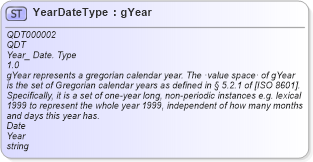
<xsd:simpleType name="YearDateType">
    <xsd:annotation>
        <xsd:documentation xml:lang="en">
            <ccts:UniqueID xmlns:ccts="urn:un:unece:uncefact:documentation:1.1">QDT000002</ccts:UniqueID>
            <ccts:CategoryCode xmlns:ccts="urn:un:unece:uncefact:documentation:1.1">QDT</ccts:CategoryCode>
            <ccts:DictionaryEntryName xmlns:ccts="urn:un:unece:uncefact:documentation:1.1">Year_ Date. Type</ccts:DictionaryEntryName>
            <ccts:VersionID xmlns:ccts="urn:un:unece:uncefact:documentation:1.1">1.0</ccts:VersionID>
            <ccts:DefinitionText xmlns:ccts="urn:un:unece:uncefact:documentation:1.1">gYear represents a gregorian calendar year. The ·value space· of gYear is the set of Gregorian calendar years as defined in § 5.2.1 of [ISO 8601]. Specifically, it is a set of one-year long, non-periodic instances e.g. lexical 1999 to represent the whole year 1999, independent of how many months and days this year has.</ccts:DefinitionText>
            <ccts:RepresentationTermName xmlns:ccts="urn:un:unece:uncefact:documentation:1.1">Date</ccts:RepresentationTermName>
            <ccts:QualifierTerm xmlns:ccts="urn:un:unece:uncefact:documentation:1.1">Year</ccts:QualifierTerm>
            <ccts:PrimitiveType xmlns:ccts="urn:un:unece:uncefact:documentation:1.1">string</ccts:PrimitiveType>
        </xsd:documentation>
    </xsd:annotation>
    <xsd:restriction base="xsd:gYear" />
</xsd:simpleType>
|
 XSD Schema Diagram: