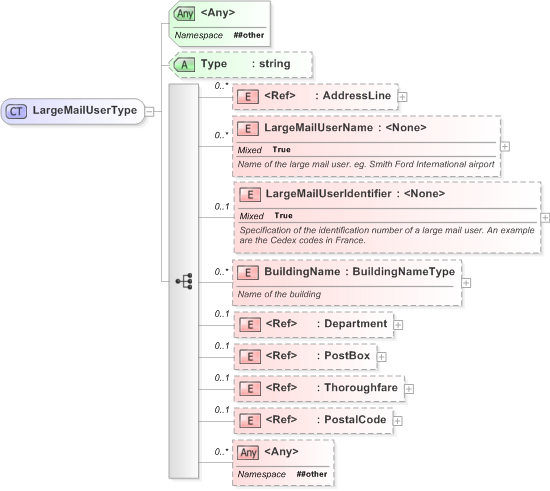
<xs:complexType name="LargeMailUserType">
    <xs:sequence>
        <xs:element ref="AddressLine" minOccurs="0" maxOccurs="unbounded" />
        <xs:element name="LargeMailUserName" minOccurs="0" maxOccurs="unbounded">
            <xs:annotation>
                <xs:documentation>Name of the large mail user. eg. Smith Ford International airport</xs:documentation>
            </xs:annotation>
            <xs:complexType mixed="true">
                <xs:attribute name="Type" type="xs:string">
                    <xs:annotation>
                        <xs:documentation>Airport, Hospital, etc</xs:documentation>
                    </xs:annotation>
                </xs:attribute>
                <xs:attribute name="Code" type="xs:string" />
                <xs:anyAttribute namespace="##other" />
            </xs:complexType>
        </xs:element>
        <xs:element name="LargeMailUserIdentifier" minOccurs="0">
            <xs:annotation>
                <xs:documentation>Specification of the identification number of a large mail user. An example are the Cedex codes in France.</xs:documentation>
            </xs:annotation>
            <xs:complexType mixed="true">
                <xs:attribute name="Type" type="xs:string">
                    <xs:annotation>
                        <xs:documentation>CEDEX Code</xs:documentation>
                    </xs:annotation>
                </xs:attribute>
                <xs:attribute name="Indicator">
                    <xs:annotation>
                        <xs:documentation>eg. Building 429 in which Building is the Indicator</xs:documentation>
                    </xs:annotation>
                </xs:attribute>
                <xs:attributeGroup ref="grPostal" />
                <xs:anyAttribute namespace="##other" />
            </xs:complexType>
        </xs:element>
        <xs:element name="BuildingName" type="BuildingNameType" minOccurs="0" maxOccurs="unbounded">
            <xs:annotation>
                <xs:documentation>Name of the building</xs:documentation>
            </xs:annotation>
        </xs:element>
        <xs:element ref="Department" minOccurs="0" />
        <xs:element ref="PostBox" minOccurs="0" />
        <xs:element ref="Thoroughfare" minOccurs="0" />
        <xs:element ref="PostalCode" minOccurs="0" />
        <xs:any namespace="##other" minOccurs="0" maxOccurs="unbounded" />
    </xs:sequence>
    <xs:attribute name="Type" type="xs:string" />
    <xs:anyAttribute namespace="##other" />
</xs:complexType>
|
 XSD Schema Diagram: