Definition Type: Element
Name: floatingRate
Namespace: http://www.fpml.org/2007/FpML-4-4
Type: fpml:FloatingRate
Containing Schema: fpml-shared-4-4.xsd
MinOccurs (1)
MaxOccurs 2
Abstract
Documentation:
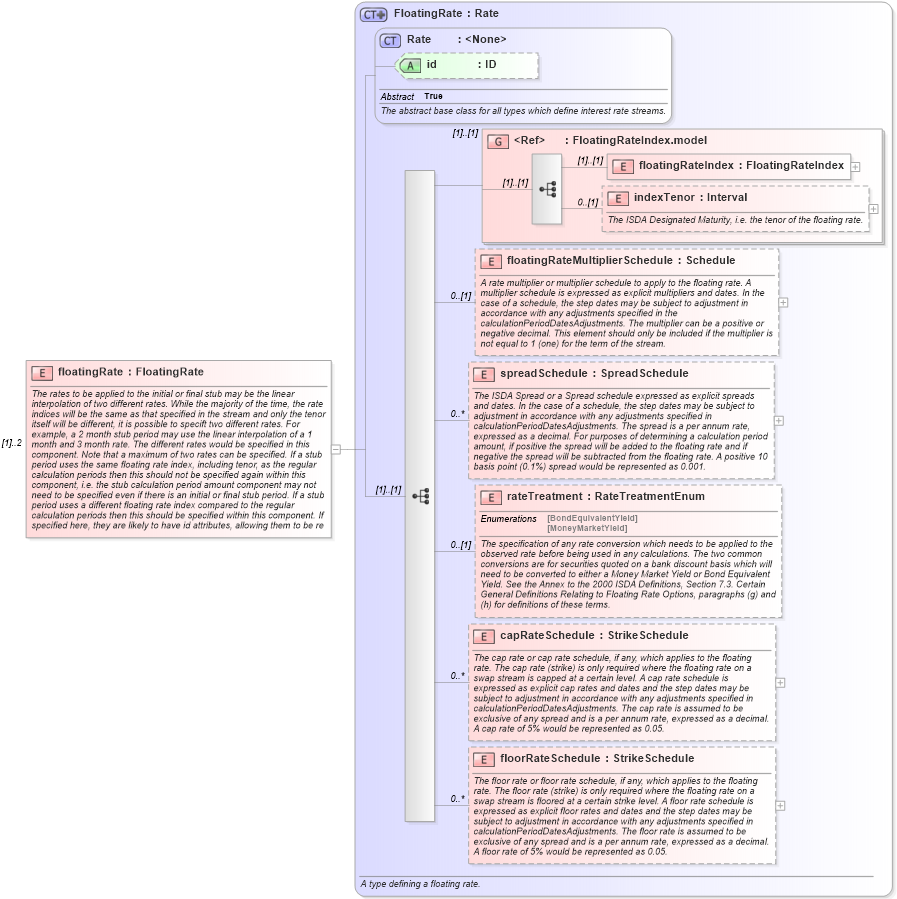
The rates to be applied to the initial or final stub may be the linear interpolation of two different rates. While the majority of the time, the rate indices will be the same as that specified in the stream and only the tenor itself will be different, it is possible to specift two different rates. For example, a 2 month stub period may use the linear interpolation of a 1 month and 3 month rate. The different rates would be specified in this component. Note that a maximum of two rates can be specified. If a stub period uses the same floating rate index, including tenor, as the regular calculation periods then this should not be specified again within this component, i.e. the stub calculation period amount component may not need to be specified even if there is an initial or final stub period. If a stub period uses a different floating rate index compared to the regular calculation periods then this should be specified within this component. If specified here, they are likely to have id attributes, allowing them to be referenced from within the cashflows component.
Collapse XSD Schema Diagram:
Drilldown into floorRateSchedule in schema fpml-shared-4-4_xsd Drilldown into capRateSchedule in schema fpml-shared-4-4_xsd Drilldown into rateTreatment in schema fpml-shared-4-4_xsd Drilldown into spreadSchedule in schema fpml-shared-4-4_xsd Drilldown into floatingRateMultiplierSchedule in schema fpml-shared-4-4_xsd Drilldown into indexTenor in schema fpml-shared-4-4_xsd Drilldown into floatingRateIndex in schema fpml-shared-4-4_xsd Drilldown into FloatingRateIndex.model in schema fpml-shared-4-4_xsd Drilldown into id in schema fpml-shared-4-4_xsd Drilldown into Rate in schema fpml-shared-4-4_xsd Drilldown into FloatingRate in schema fpml-shared-4-4_xsdXSD Diagram of floatingRate in schema fpml-shared-4-4_xsd (Financial products Markup Language (FpML®))
Collapse XSD Schema Code:
<xsd:element name="floatingRate" type="FloatingRate" maxOccurs="2">
    <xsd:annotation>
        <xsd:documentation xml:lang="en">The rates to be applied to the initial or final stub may be the linear interpolation of two different rates. While the majority of the time, the rate indices will be the same as that specified in the stream and only the tenor itself will be different, it is possible to specift two different rates. For example, a 2 month stub period may use the linear interpolation of a 1 month and 3 month rate. The different rates would be specified in this component. Note that a maximum of two rates can be specified. If a stub period uses the same floating rate index, including tenor, as the regular calculation periods then this should not be specified again within this component, i.e. the stub calculation period amount component may not need to be specified even if there is an initial or final stub period. If a stub period uses a different floating rate index compared to the regular calculation periods then this should be specified within this component. If specified here, they are likely to have id attributes, allowing them to be referenced from within the cashflows component.</xsd:documentation>
    </xsd:annotation>
</xsd:element>
Collapse Child Elements:
Name Type Min Occurs Max Occurs
floatingRateIndex fpml:floatingRateIndex (1) (1)
indexTenor fpml:indexTenor 0 (1)
floatingRateMultiplierSchedule fpml:floatingRateMultiplierSchedule 0 (1)
spreadSchedule fpml:spreadSchedule 0 unbounded
rateTreatment fpml:rateTreatment 0 (1)
capRateSchedule fpml:capRateSchedule 0 unbounded
floorRateSchedule fpml:floorRateSchedule 0 unbounded
<xs:group> fpml:FloatingRateIndex.model (1) (1)
Collapse Child Attributes:
Name Type Default Value Use
id fpml:id (Optional)
Collapse Derivation Tree: