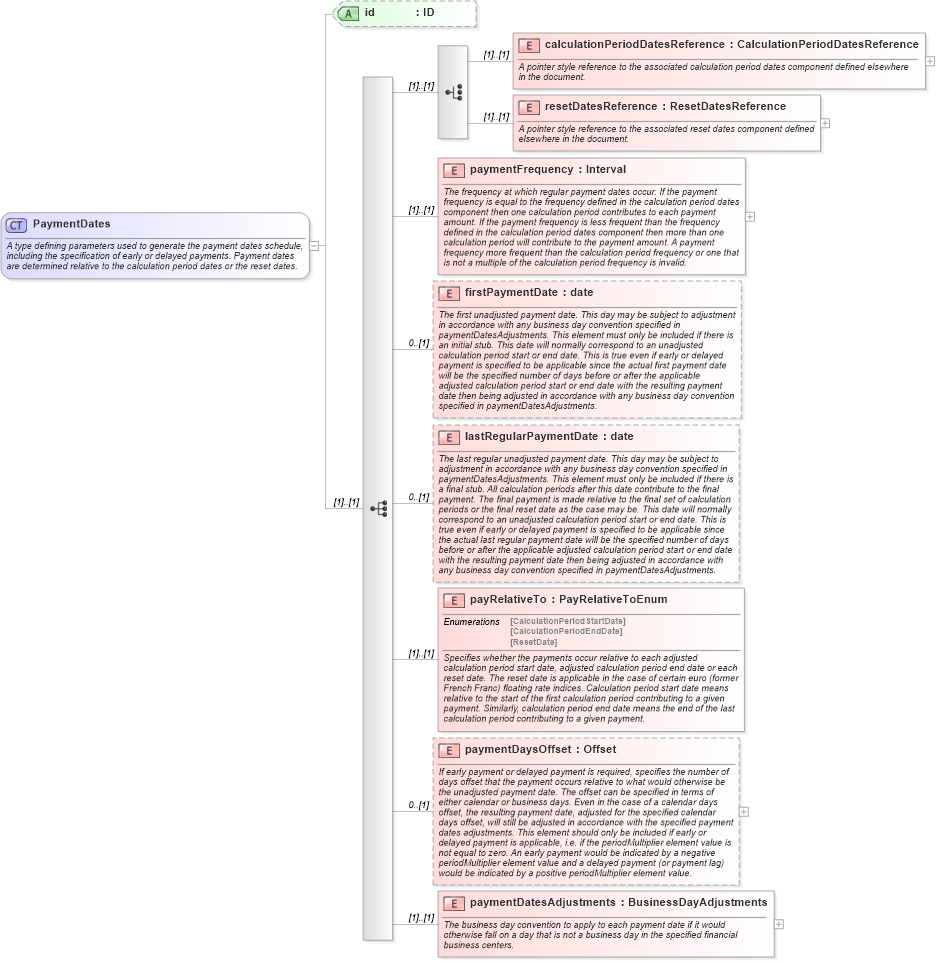
<xsd:complexType name="PaymentDates">
    <xsd:annotation>
        <xsd:documentation xml:lang="en">A type defining parameters used to generate the payment dates schedule, including the specification of early or delayed payments. Payment dates are determined relative to the calculation period dates or the reset dates.</xsd:documentation>
    </xsd:annotation>
    <xsd:sequence>
        <xsd:choice>
            <xsd:element name="calculationPeriodDatesReference" type="CalculationPeriodDatesReference">
                <xsd:annotation>
                    <xsd:documentation xml:lang="en">A pointer style reference to the associated calculation period dates component defined elsewhere in the document.</xsd:documentation>
                </xsd:annotation>
            </xsd:element>
            <xsd:element name="resetDatesReference" type="ResetDatesReference">
                <xsd:annotation>
                    <xsd:documentation xml:lang="en">A pointer style reference to the associated reset dates component defined elsewhere in the document.</xsd:documentation>
                </xsd:annotation>
            </xsd:element>
        </xsd:choice>
        <xsd:element name="paymentFrequency" type="Interval">
            <xsd:annotation>
                <xsd:documentation xml:lang="en">The frequency at which regular payment dates occur. If the payment frequency is equal to the frequency defined in the calculation period dates component then one calculation period contributes to each payment amount. If the payment frequency is less frequent than the frequency defined in the calculation period dates component then more than one calculation period will contribute to the payment amount. A payment frequency more frequent than the calculation period frequency or one that is not a multiple of the calculation period frequency is invalid.</xsd:documentation>
            </xsd:annotation>
        </xsd:element>
        <xsd:element name="firstPaymentDate" type="xsd:date" minOccurs="0">
            <xsd:annotation>
                <xsd:documentation xml:lang="en">The first unadjusted payment date. This day may be subject to adjustment in accordance with any business day convention specified in paymentDatesAdjustments. This element must only be included if there is an initial stub. This date will normally correspond to an unadjusted calculation period start or end date. This is true even if early or delayed payment is specified to be applicable since the actual first payment date will be the specified number of days before or after the applicable adjusted calculation period start or end date with the resulting payment date then being adjusted in accordance with any business day convention specified in paymentDatesAdjustments.</xsd:documentation>
            </xsd:annotation>
        </xsd:element>
        <xsd:element name="lastRegularPaymentDate" type="xsd:date" minOccurs="0">
            <xsd:annotation>
                <xsd:documentation xml:lang="en">The last regular unadjusted payment date. This day may be subject to adjustment in accordance with any business day convention specified in paymentDatesAdjustments. This element must only be included if there is a final stub. All calculation periods after this date contribute to the final payment. The final payment is made relative to the final set of calculation periods or the final reset date as the case may be. This date will normally correspond to an unadjusted calculation period start or end date. This is true even if early or delayed payment is specified to be applicable since the actual last regular payment date will be the specified number of days before or after the applicable adjusted calculation period start or end date with the resulting payment date then being adjusted in accordance with any business day convention specified in paymentDatesAdjustments.</xsd:documentation>
            </xsd:annotation>
        </xsd:element>
        <xsd:element name="payRelativeTo" type="PayRelativeToEnum">
            <xsd:annotation>
                <xsd:documentation xml:lang="en">Specifies whether the payments occur relative to each adjusted calculation period start date, adjusted calculation period end date or each reset date. The reset date is applicable in the case of certain euro (former French Franc) floating rate indices. Calculation period start date means relative to the start of the first calculation period contributing to a given payment. Similarly, calculation period end date means the end of the last calculation period contributing to a given payment.</xsd:documentation>
            </xsd:annotation>
        </xsd:element>
        <xsd:element name="paymentDaysOffset" type="Offset" minOccurs="0">
            <xsd:annotation>
                <xsd:documentation xml:lang="en">If early payment or delayed payment is required, specifies the number of days offset that the payment occurs relative to what would otherwise be the unadjusted payment date. The offset can be specified in terms of either calendar or business days. Even in the case of a calendar days offset, the resulting payment date, adjusted for the specified calendar days offset, will still be adjusted in accordance with the specified payment dates adjustments. This element should only be included if early or delayed payment is applicable, i.e. if the periodMultiplier element value is not equal to zero. An early payment would be indicated by a negative periodMultiplier element value and a delayed payment (or payment lag) would be indicated by a positive periodMultiplier element value.</xsd:documentation>
            </xsd:annotation>
        </xsd:element>
        <xsd:element name="paymentDatesAdjustments" type="BusinessDayAdjustments">
            <xsd:annotation>
                <xsd:documentation xml:lang="en">The business day convention to apply to each payment date if it would otherwise fall on a day that is not a business day in the specified financial business centers.</xsd:documentation>
            </xsd:annotation>
        </xsd:element>
    </xsd:sequence>
    <xsd:attribute name="id" type="xsd:ID" />
</xsd:complexType>
|
 XSD Schema Diagram: