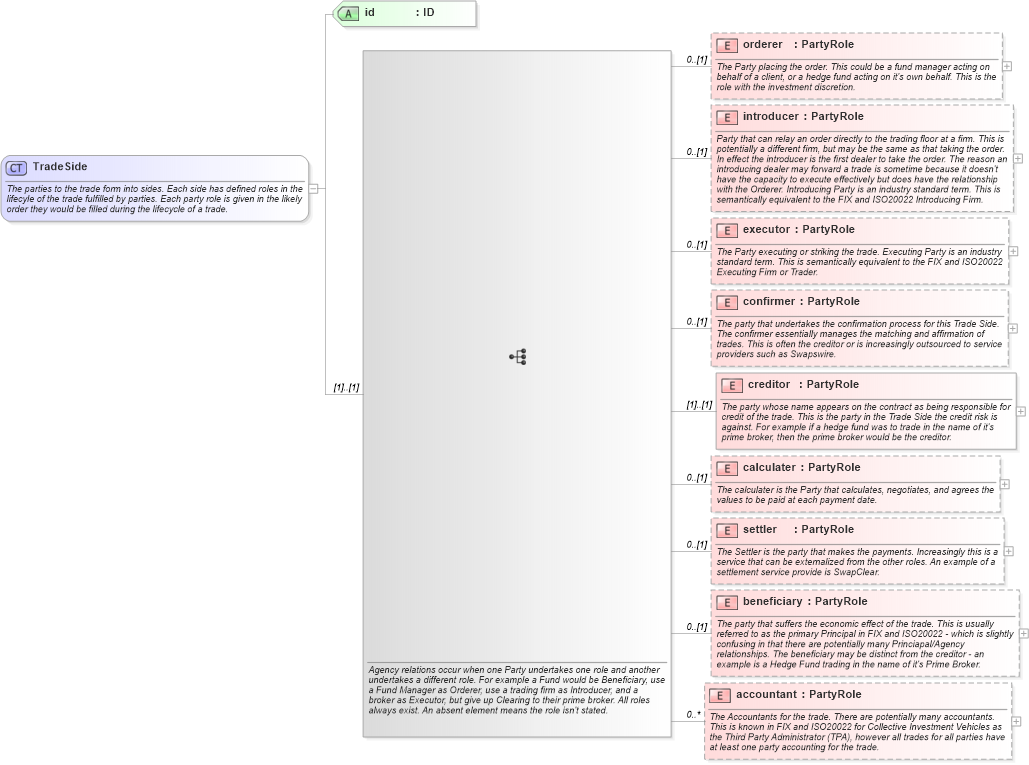
<xsd:complexType name="TradeSide">
    <xsd:annotation>
        <xsd:documentation xml:lang="en">The parties to the trade form into sides. Each side has defined roles in the lifecyle of the trade fulfilled by parties. Each party role is given in the likely order they would be filled during the lifecycle of a trade.</xsd:documentation>
    </xsd:annotation>
    <xsd:sequence>
        <xsd:annotation>
            <xsd:documentation xml:lang="en">Agency relations occur when one Party undertakes one role and another undertakes a different role. For example a Fund would be Beneficiary, use a Fund Manager as Orderer, use a trading firm as Introducer, and a broker as Executor, but give up Clearing to their prime broker. All roles always exist. An absent element means the role isn't stated.</xsd:documentation>
        </xsd:annotation>
        <xsd:element name="orderer" type="PartyRole" minOccurs="0">
            <xsd:annotation>
                <xsd:documentation xml:lang="en">The Party placing the order. This could be a fund manager acting on behalf of a client, or a hedge fund acting on it's own behalf. This is the role with the investment discretion.</xsd:documentation>
            </xsd:annotation>
        </xsd:element>
        <xsd:element name="introducer" type="PartyRole" minOccurs="0">
            <xsd:annotation>
                <xsd:documentation xml:lang="en">Party that can relay an order directly to the trading floor at a firm. This is potentially a different firm, but may be the same as that taking the order. In effect the introducer is the first dealer to take the order. The reason an introducing dealer may forward a trade is sometime because it doesn't have the capacity to execute effectively but does have the relationship with the Orderer. Introducing Party is an industry standard term. This is semantically equivalent to the FIX and ISO20022 Introducing Firm.</xsd:documentation>
            </xsd:annotation>
        </xsd:element>
        <xsd:element name="executor" type="PartyRole" minOccurs="0">
            <xsd:annotation>
                <xsd:documentation xml:lang="en">The Party executing or striking the trade. Executing Party is an industry standard term. This is semantically equivalent to the FIX and ISO20022 Executing Firm or Trader.</xsd:documentation>
            </xsd:annotation>
        </xsd:element>
        <xsd:element name="confirmer" type="PartyRole" minOccurs="0">
            <xsd:annotation>
                <xsd:documentation xml:lang="en">The party that undertakes the confirmation process for this Trade Side. The confirmer essentially manages the matching and affirmation of trades. This is often the creditor or is increasingly outsourced to service providers such as Swapswire.</xsd:documentation>
            </xsd:annotation>
        </xsd:element>
        <xsd:element name="creditor" type="PartyRole">
            <xsd:annotation>
                <xsd:documentation xml:lang="en">The party whose name appears on the contract as being responsible for credit of the trade. This is the party in the Trade Side the credit risk is against. For example if a hedge fund was to trade in the name of it's prime broker, then the prime broker would be the creditor.</xsd:documentation>
            </xsd:annotation>
        </xsd:element>
        <xsd:element name="calculater" type="PartyRole" minOccurs="0">
            <xsd:annotation>
                <xsd:documentation xml:lang="en">The calculater is the Party that calculates, negotiates, and agrees the values to be paid at each payment date.</xsd:documentation>
            </xsd:annotation>
        </xsd:element>
        <xsd:element name="settler" type="PartyRole" minOccurs="0">
            <xsd:annotation>
                <xsd:documentation xml:lang="en">The Settler is the party that makes the payments. Increasingly this is a service that can be externalized from the other roles. An example of a settlement service provide is SwapClear.</xsd:documentation>
            </xsd:annotation>
        </xsd:element>
        <xsd:element name="beneficiary" type="PartyRole" minOccurs="0">
            <xsd:annotation>
                <xsd:documentation xml:lang="en">The party that suffers the economic effect of the trade. This is usually referred to as the primary Principal in FIX and ISO20022 - which is slightly confusing in that there are potentially many Princiapal/Agency relationships. The beneficiary may be distinct from the creditor - an example is a Hedge Fund trading in the name of it's Prime Broker.</xsd:documentation>
            </xsd:annotation>
        </xsd:element>
        <xsd:element name="accountant" type="PartyRole" minOccurs="0" maxOccurs="unbounded">
            <xsd:annotation>
                <xsd:documentation xml:lang="en">The Accountants for the trade. There are potentially many accountants. This is known in FIX and ISO20022 for Collective Investment Vehicles as the Third Party Administrator (TPA), however all trades for all parties have at least one party accounting for the trade.</xsd:documentation>
            </xsd:annotation>
        </xsd:element>
    </xsd:sequence>
    <xsd:attribute name="id" type="xsd:ID" use="required" />
</xsd:complexType>
|
 XSD Schema Diagram: