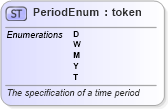
<xsd:simpleType name="PeriodEnum">
    <xsd:annotation>
        <xsd:documentation source="http://www.FpML.org" xml:lang="en">The specification of a time period</xsd:documentation>
    </xsd:annotation>
    <xsd:restriction base="xsd:token">
        <xsd:enumeration value="D">
            <xsd:annotation>
                <xsd:documentation source="http://www.FpML.org" xml:lang="en">Day.</xsd:documentation>
            </xsd:annotation>
        </xsd:enumeration>
        <xsd:enumeration value="W">
            <xsd:annotation>
                <xsd:documentation source="http://www.FpML.org" xml:lang="en">Week.</xsd:documentation>
            </xsd:annotation>
        </xsd:enumeration>
        <xsd:enumeration value="M">
            <xsd:annotation>
                <xsd:documentation source="http://www.FpML.org" xml:lang="en">Month.</xsd:documentation>
            </xsd:annotation>
        </xsd:enumeration>
        <xsd:enumeration value="Y">
            <xsd:annotation>
                <xsd:documentation source="http://www.FpML.org" xml:lang="en">Year.</xsd:documentation>
            </xsd:annotation>
        </xsd:enumeration>
        <xsd:enumeration value="T">
            <xsd:annotation>
                <xsd:documentation source="http://www.FpML.org" xml:lang="en">Term. The period commencing on the effective date and ending on the termination date. The T period always appears in association with periodMultiplier = 1, and the notation is intended for use in contexts where the interval thus qualified (e.g. accrual period, payment period, reset period, ...) spans the entire term of the trade.</xsd:documentation>
            </xsd:annotation>
        </xsd:enumeration>
    </xsd:restriction>
</xsd:simpleType>
|
 XSD Schema Diagram:
 Facets: