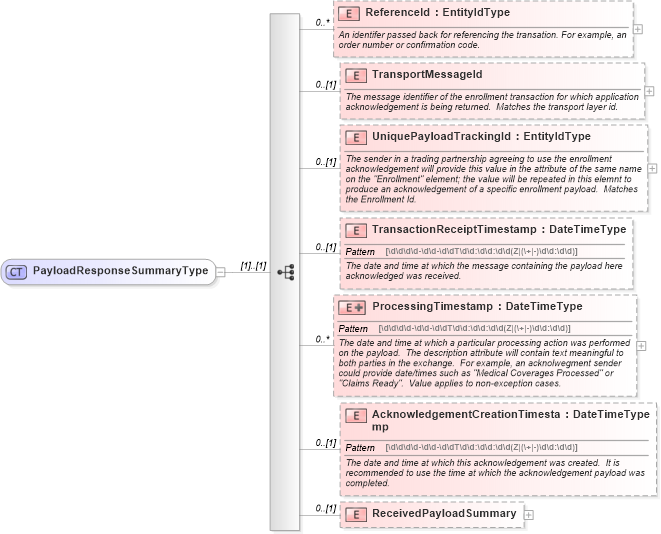
<xsd:complexType name="PayloadResponseSummaryType">
    <xsd:sequence>
        <xsd:element name="ReferenceId" type="EntityIdType" minOccurs="0" maxOccurs="unbounded">
            <xsd:annotation>
                <xsd:documentation>An identifer passed back for referencing the transation. For example, an order number or confirmation code.</xsd:documentation>
            </xsd:annotation>
        </xsd:element>
        <xsd:element name="TransportMessageId" minOccurs="0">
            <xsd:annotation>
                <xsd:documentation>The message identifier of the enrollment transaction for which application acknowledgement is being returned.  Matches the transport layer id.</xsd:documentation>
            </xsd:annotation>
            <xsd:complexType>
                <xsd:sequence>
                    <xsd:element name="MessageIdType" type="xsd:string" minOccurs="0" />
                    <xsd:element name="MessageId" type="EntityIdType" />
                </xsd:sequence>
            </xsd:complexType>
        </xsd:element>
        <xsd:element name="UniquePayloadTrackingId" type="EntityIdType" minOccurs="0">
            <xsd:annotation>
                <xsd:documentation>The sender in a trading partnership agreeing to use the enrollment acknowledgement will provide this value in the attribute of the same name on the "Enrollment" element; the value will be repeated in this elemnt to produce an acknowledgement of a specific enrollment payload.  Matches the Enrollment Id.</xsd:documentation>
            </xsd:annotation>
        </xsd:element>
        <xsd:element name="TransactionReceiptTimestamp" type="DateTimeType" minOccurs="0">
            <xsd:annotation>
                <xsd:documentation>The date and time at which the message containing the payload here acknowledged was received.</xsd:documentation>
            </xsd:annotation>
        </xsd:element>
        <xsd:element name="ProcessingTimestamp" minOccurs="0" maxOccurs="unbounded">
            <xsd:annotation>
                <xsd:documentation>The date and time at which a particular processing action was performed on the payload.  The description attribute will contain text meaningful to both parties in the exchange.  For example, an acknolwegment sender could provide date/times such as "Medical Coverages Processed" or "Claims Ready".  Value applies to non-exception cases.</xsd:documentation>
            </xsd:annotation>
            <xsd:complexType>
                <xsd:simpleContent>
                    <xsd:extension base="DateTimeType">
                        <xsd:attribute name="description" type="xsd:string" />
                    </xsd:extension>
                </xsd:simpleContent>
            </xsd:complexType>
        </xsd:element>
        <xsd:element name="AcknowledgementCreationTimestamp" type="DateTimeType" minOccurs="0">
            <xsd:annotation>
                <xsd:documentation>The date and time at which this acknowledgement was created.  It is recommended to use the time at which the acknowledgement payload was completed.</xsd:documentation>
            </xsd:annotation>
        </xsd:element>
        <xsd:element name="ReceivedPayloadSummary" minOccurs="0">
            <xsd:complexType>
                <xsd:sequence>
                    <xsd:element name="ReceivedPayloadSchemaURI" type="xsd:anyURI" minOccurs="0">
                        <xsd:annotation>
                            <xsd:documentation>A URI indicating where the schema used to create the enrolment payload being acknowledged can be found.</xsd:documentation>
                        </xsd:annotation>
                    </xsd:element>
                    <xsd:element name="EntityInfo" minOccurs="0" maxOccurs="unbounded">
                        <xsd:complexType>
                            <xsd:sequence>
                                <xsd:element name="EntityInstanceAxisXPath" type="xsd:string" minOccurs="0">
                                    <xsd:annotation>
                                        <xsd:documentation>An XPath to the entity level in the xml instance.  It does not indicate which occurrence of the entity, only the axis.  For example, it may be Enrollment/Organization/Subscriber - not indicating which Subscriber occurrence. The instance is located by ReceivedPayloadSchemaURI.</xsd:documentation>
                                    </xsd:annotation>
                                </xsd:element>
                                <xsd:element name="Count" type="xsd:nonNegativeInteger">
                                    <xsd:annotation>
                                        <xsd:documentation>The number of items referreed to in the EntitySchemaXPath element.</xsd:documentation>
                                    </xsd:annotation>
                                </xsd:element>
                                <xsd:element name="EntityShortName" type="xsd:string" minOccurs="0">
                                    <xsd:annotation>
                                        <xsd:documentation>A non-standard or shorter name for the entities identified by the EntityXPath  (e.g. "Families with Medical Coverage" or "Life Insurance Coverages with Total Volume Over 2 million dollars".</xsd:documentation>
                                    </xsd:annotation>
                                </xsd:element>
                            </xsd:sequence>
                        </xsd:complexType>
                    </xsd:element>
                </xsd:sequence>
            </xsd:complexType>
        </xsd:element>
    </xsd:sequence>
</xsd:complexType>
|
 XSD Schema Diagram: