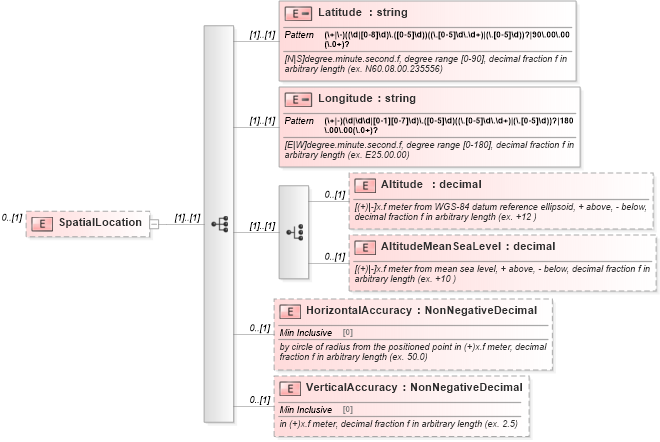
<xsd:element name="SpatialLocation" minOccurs="0">
    <xsd:complexType>
        <xsd:sequence>
            <xsd:element name="Latitude">
                <xsd:annotation>
                    <xsd:documentation>[N|S]degree.minute.second.f, degree range [0-90], decimal fraction f in arbitrary length (ex. N60.08.00.235556)</xsd:documentation>
                </xsd:annotation>
                <xsd:simpleType>
                    <xsd:restriction base="xsd:string">
                        <xsd:pattern value="(\+|\-)((\d|[0-8]\d)\.([0-5]\d))((\.[0-5]\d\.\d+)|(\.[0-5]\d))?|90\.00\.00(\.0+)?">
                            <xsd:annotation>
                                <xsd:documentation>
Pattern is generally of the form +DD.MM.SS  (D=degrees, M=minutes, S=seconds)

Description of the pattern:
1) '+' or '-' required unless the value is 90.00.00
	- if value is 90.00.00, then omit the '+' or '-'
	- '+' means North, '-' means South
2) A one-digit or two-digit number for degrees (range 0 to 89) - required
3) A dot (the decimal between degrees and minutes) - required
4) A two-digit number for minutes (range 00 to 59) - required
5) A dot (the decimal between minutes and seconds) - optional
6) A two-digit number for seconds (range 00 to 59) - optional
     - if there is a dot in step 5, then there must be a two-digit number for seconds
7) A dot (the decimal between seconds and parts of a second) - optional
8) Digits for parts of a second (can be any number of digits) - optional
     - if there is a dot in step 7, then there must be at least one digit after it

Examples:
+0.00.00
+00.00.00
90.00.00
90.00.00.0
-89.59.59
-89.59
-89.59.59.555


Pattern breakdown: (D=degrees, M=minutes, S=seconds)
(\+|\-)  (...see next line..)  |     90\.00\.00(\.0+)? <!-- choice of:  +(...DD.MM.SS pattern...) OR 90.00.00 -->
((\d|[0-8]\d)\.([0-5]\d))  (...see next line..) <!-- D (0-9), DD (00-89), and MM (00-59) ranges defined, followed by ... -->
((\.[0-5]\d\.\d+)   |   (\.[0-5]\d))?<!-- SS with decimal fractions of S *OR* SS without fractions of S *OR* no SS at all -->


The original pattern (just for insurance):
pattern value="(N|S)((\d|[0-8]\d)\.([0-5]\d)\.[0-5]\d(\.\d+)?)|90\.00\.00(\.0+)?"


			</xsd:documentation>
                            </xsd:annotation>
                        </xsd:pattern>
                    </xsd:restriction>
                </xsd:simpleType>
            </xsd:element>
            <xsd:element name="Longitude">
                <xsd:annotation>
                    <xsd:documentation>[E|W]degree.minute.second.f, degree range [0-180], decimal fraction f in arbitrary length (ex. E25.00.00)</xsd:documentation>
                </xsd:annotation>
                <xsd:simpleType>
                    <xsd:restriction base="xsd:string">
                        <xsd:pattern value="(\+|-)(\d|\d\d|[0-1][0-7]\d)\.([0-5]\d)((\.[0-5]\d\.\d+)|(\.[0-5]\d))?|180\.00\.00(\.0+)?">
                            <xsd:annotation>
                                <xsd:documentation>
Pattern is generally of the form +DDD.MM.SS  (D=degrees, M=minutes, S=seconds)

Description of the pattern:
1) '+' or '-' required unless the value is 180.00.00
	- if 180.00.00, then omit the '+' or '-'
	- '+' means East, '-' means West
2) A one-digit, two-digit, or three-digit number for degrees (range 0 to 179) - required
3) A dot (the decimal between degrees and minutes) - required
4) A two-digit number for minutes (range 00 to 59) - required
5) A dot (the decimal between minutes and seconds) - optional
6) A two-digit number for seconds (range 00 to 59) - optional
     - if there is a dot in step 5, then there must be a two-digit number for seconds
7) A dot (the decimal between seconds and parts of a second) - optional
8) Digits for parts of a second (can be any number of digits) - optional
     - if there is a dot in step 7, then there must be at least one digit after it

Examples:
+0.00.00
+00.00.00
+000.00.00
180.00.00
180.00.00.0
-179.59.59
-40.59.59.555
-40.59


Pattern breakdown: (D=degrees, M=minutes, S=seconds)
(\+|\-)  (...see next line..)  |     190\.00\.00(\.0+)? <!-- choice of:  +(...DDD.MM.SS pattern...) OR 180.00.00 -->
(\d|\d\d|[0-1][0-7]\d)\.([0-5]\d)  (...see next line..) <!-- D (0-9), DD (00-99), DDD (000-179) and MM (00-59) ranges defined, followed by ... -->
((\.[0-5]\d\.\d+)   |   (\.[0-5]\d))?<!-- SS with decimal fractions of S *OR* SS without fractions of S *OR* no SS at all -->


The original pattern (just for insurance):
pattern value="(E|W)((\d|\d\d|[0-1][0-7]\d)\.([0-5]\d)\.[0-5]\d(\.\d+)?)|180\.00\.00(\.0+)?"
			</xsd:documentation>
                            </xsd:annotation>
                        </xsd:pattern>
                    </xsd:restriction>
                </xsd:simpleType>
            </xsd:element>
            <xsd:choice>
                <xsd:element name="Altitude" type="xsd:decimal" minOccurs="0">
                    <xsd:annotation>
                        <xsd:documentation>[(+)|-]x.f meter from WGS-84 datum reference ellipsoid, + above, - below, decimal fraction f in arbitrary length (ex. +12 )</xsd:documentation>
                    </xsd:annotation>
                </xsd:element>
                <xsd:element name="AltitudeMeanSeaLevel" type="xsd:decimal" minOccurs="0">
                    <xsd:annotation>
                        <xsd:documentation>[(+)|-]x.f meter from mean sea level, + above, - below, decimal fraction f in arbitrary length (ex. +10 )</xsd:documentation>
                    </xsd:annotation>
                </xsd:element>
            </xsd:choice>
            <xsd:element name="HorizontalAccuracy" type="NonNegativeDecimal" minOccurs="0">
                <xsd:annotation>
                    <xsd:documentation>by circle of radius from the positioned point in (+)x.f meter, decimal fraction f in arbitrary length (ex. 50.0)</xsd:documentation>
                </xsd:annotation>
            </xsd:element>
            <xsd:element name="VerticalAccuracy" type="NonNegativeDecimal" minOccurs="0">
                <xsd:annotation>
                    <xsd:documentation>in (+)x.f meter, decimal fraction f in arbitrary length (ex. 2.5)</xsd:documentation>
                </xsd:annotation>
            </xsd:element>
        </xsd:sequence>
    </xsd:complexType>
</xsd:element>
|
 XSD Schema Diagram: