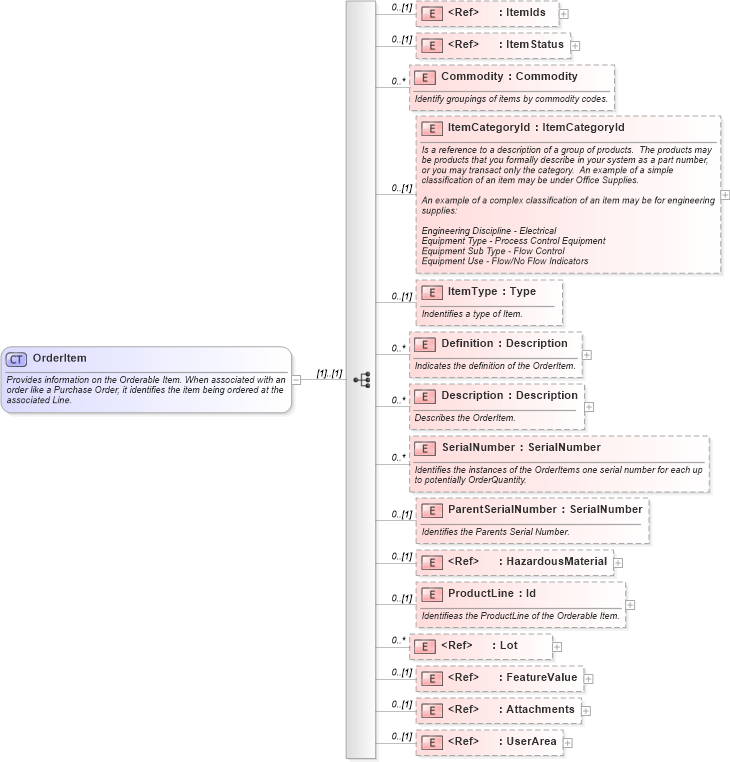
<xs:complexType name="OrderItem">
    <xs:annotation>
        <xs:documentation source="http://www.openapplications.org/oagis">Provides information on the Orderable Item. When associated with an order like a Purchase Order, it identifies the item being ordered at the associated Line.</xs:documentation>
    </xs:annotation>
    <xs:sequence>
        <xs:element ref="ItemIds" minOccurs="0" />
        <xs:element ref="ItemStatus" minOccurs="0" />
        <xs:element name="Commodity" type="Commodity" minOccurs="0" maxOccurs="unbounded">
            <xs:annotation>
                <xs:documentation source="http://www.openapplications.org/oagis">Identify groupings of items by commodity codes.</xs:documentation>
            </xs:annotation>
        </xs:element>
        <xs:element name="ItemCategoryId" type="ItemCategoryId" minOccurs="0">
            <xs:annotation>
                <xs:documentation source="http://www.openapplications.org/oagis">Is a reference to a description of a group of products.  The products may be products that you formally describe in your system as a part number, or you may transact only the category.  An example of a simple classification of an item may be under Office Supplies.

An example of a complex classification of an item may be for engineering supplies:

Engineering Discipline - Electrical
Equipment Type - Process Control Equipment
Equipment Sub Type - Flow Control
Equipment Use - Flow/No Flow Indicators</xs:documentation>
            </xs:annotation>
        </xs:element>
        <xs:element name="ItemType" type="Type" minOccurs="0">
            <xs:annotation>
                <xs:documentation source="http://www.openapplications.org/oagis">Indentifies a type of Item.</xs:documentation>
            </xs:annotation>
        </xs:element>
        <xs:element name="Definition" type="Description" minOccurs="0" maxOccurs="unbounded">
            <xs:annotation>
                <xs:documentation source="http://www.openapplications.org/oagis">Indicates the definition of the OrderItem.</xs:documentation>
            </xs:annotation>
        </xs:element>
        <xs:element name="Description" type="Description" minOccurs="0" maxOccurs="unbounded">
            <xs:annotation>
                <xs:documentation source="http://www.openapplications.org/oagis">Describes the OrderItem.</xs:documentation>
            </xs:annotation>
        </xs:element>
        <xs:element name="SerialNumber" type="SerialNumber" minOccurs="0" maxOccurs="unbounded">
            <xs:annotation>
                <xs:documentation source="http://www.openapplications.org/oagis">Identifies the instances of the OrderItems one serial number for each up to potentially OrderQuantity.</xs:documentation>
            </xs:annotation>
        </xs:element>
        <xs:element name="ParentSerialNumber" type="SerialNumber" minOccurs="0">
            <xs:annotation>
                <xs:documentation source="http://www.openapplications.org/oagis">Identifies the Parents Serial Number.</xs:documentation>
            </xs:annotation>
        </xs:element>
        <xs:element ref="HazardousMaterial" minOccurs="0">
            <xs:annotation>
                <xs:documentation source="http://www.openapplications.org/oagis">Needs to be typed with HazardousMaterial structure</xs:documentation>
            </xs:annotation>
        </xs:element>
        <xs:element name="ProductLine" type="Id" minOccurs="0">
            <xs:annotation>
                <xs:documentation source="http://www.openapplications.org/oagis">Identifieas the ProductLine of the Orderable Item.</xs:documentation>
            </xs:annotation>
        </xs:element>
        <xs:element ref="Lot" minOccurs="0" maxOccurs="unbounded">
            <xs:annotation>
                <xs:documentation source="http://www.openapplications.org/oagis">Indicates the LotLevel of the Orderable Item.</xs:documentation>
            </xs:annotation>
        </xs:element>
        <xs:element ref="FeatureValue" minOccurs="0" />
        <xs:element ref="Attachments" minOccurs="0" />
        <xs:element ref="UserArea" minOccurs="0" />
    </xs:sequence>
</xs:complexType>
|
 XSD Schema Diagram: