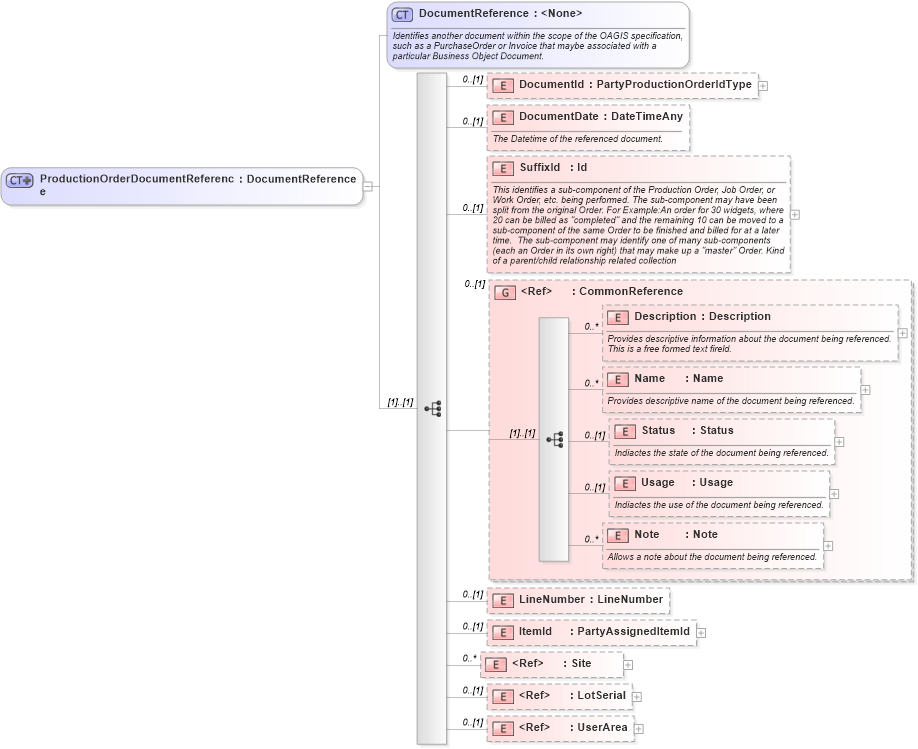
<xs:complexType name="ProductionOrderDocumentReference">
    <xs:complexContent>
        <xs:extension base="DocumentReference">
            <xs:sequence>
                <xs:element name="DocumentId" type="PartyProductionOrderIdType" minOccurs="0" />
                <xs:element name="DocumentDate" type="DateTimeAny" minOccurs="0">
                    <xs:annotation>
                        <xs:documentation source="http://www.openapplications.org/oagis">The Datetime of the referenced document.</xs:documentation>
                    </xs:annotation>
                </xs:element>
                <xs:element name="SuffixId" type="Id" minOccurs="0">
                    <xs:annotation>
                        <xs:documentation source="http://www.openapplications.org/oagis">This identifies a sub-component of the Production Order, Job Order, or Work Order, etc. being performed. The sub-component may have been split from the original Order. For Example:An order for 30 widgets, where 20 can be billed as "completed" and the remaining 10 can be moved to a sub-component of the same Order to be finished and billed for at a later time.  The sub-component may identify one of many sub-components (each an Order in its own right) that may make up a "master" Order. Kind of a parent/child relationship related collection</xs:documentation>
                    </xs:annotation>
                </xs:element>
                <xs:group ref="CommonReference" minOccurs="0" />
                <xs:element name="LineNumber" type="LineNumber" minOccurs="0" />
                <xs:element name="ItemId" type="PartyAssignedItemId" minOccurs="0" />
                <xs:element ref="Site" minOccurs="0" maxOccurs="unbounded" />
                <xs:element ref="LotSerial" minOccurs="0" />
                <xs:element ref="UserArea" minOccurs="0" />
            </xs:sequence>
        </xs:extension>
    </xs:complexContent>
</xs:complexType>
|
 XSD Schema Diagram: