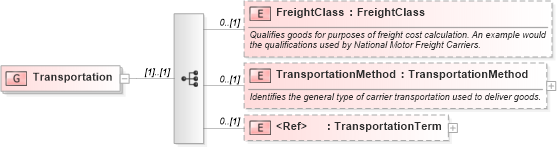
<xs:group name="Transportation">
    <xs:sequence>
        <xs:element name="FreightClass" type="FreightClass" minOccurs="0">
            <xs:annotation>
                <xs:documentation source="http://www.openapplications.org/oagis">Qualifies goods for purposes of freight cost calculation. An example would the qualifications used by National Motor Freight Carriers.</xs:documentation>
            </xs:annotation>
        </xs:element>
        <xs:element name="TransportationMethod" type="TransportationMethod" minOccurs="0">
            <xs:annotation>
                <xs:documentation source="http://www.openapplications.org/oagis">Identifies the general type of carrier transportation used to deliver goods.</xs:documentation>
            </xs:annotation>
        </xs:element>
        <xs:element ref="TransportationTerm" minOccurs="0">
            <xs:annotation>
                <xs:documentation source="http://www.openapplications.org/oagis">Is a contractual code used to describe the point where delivery occurs (goods ownership is transferred) in a contract of sale.  It identifies the rights and obligations of each partner  (supplier, carrier and customer) in the transaction and may specify the requirements to assume ownership (i.e. paying for the cost of the goods and/or transportation). The United Nations Trade Facilitation Information Exchange (UN/TraFIX) has established the following codes (INCOTERMS 1990) for use in international trade to Europe, Asia and the Pacific.  (See http://www.unece.org/trade/rec/rec05en.htm).  These terms may also be found in the United States Uniform Commercial Code (UCC).</xs:documentation>
            </xs:annotation>
        </xs:element>
    </xs:sequence>
</xs:group>
|
 XSD Schema Diagram: