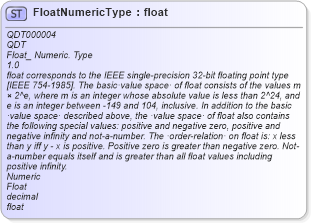
<xsd:simpleType name="FloatNumericType">
    <xsd:annotation>
        <xsd:documentation xml:lang="en">
            <ccts:UniqueID xmlns:ccts="urn:un:unece:uncefact:documentation:1.1">QDT000004</ccts:UniqueID>
            <ccts:CategoryCode xmlns:ccts="urn:un:unece:uncefact:documentation:1.1">QDT</ccts:CategoryCode>
            <ccts:DictionaryEntryName xmlns:ccts="urn:un:unece:uncefact:documentation:1.1">Float_ Numeric. Type</ccts:DictionaryEntryName>
            <ccts:VersionID xmlns:ccts="urn:un:unece:uncefact:documentation:1.1">1.0</ccts:VersionID>
            <ccts:DefinitionText xmlns:ccts="urn:un:unece:uncefact:documentation:1.1">float corresponds to the IEEE single-precision 32-bit floating point type [IEEE 754-1985]. The basic·value space· of float consists of the values m × 2^e, where m is an integer whose absolute value is less than 2^24, and e is an integer between -149 and 104, inclusive. In addition to the basic ·value space· described above, the ·value space· of float also contains the following special values: positive and negative zero, positive and negative infinity and not-a-number. The ·order-relation· on float is: x less than y iff y - x is positive. Positive zero is greater than negative zero. Not-a-number equals itself and is greater than all float values including positive infinity.</ccts:DefinitionText>
            <ccts:RepresentationTermName xmlns:ccts="urn:un:unece:uncefact:documentation:1.1">Numeric</ccts:RepresentationTermName>
            <ccts:QualifierTerm xmlns:ccts="urn:un:unece:uncefact:documentation:1.1">Float</ccts:QualifierTerm>
            <ccts:PrimitiveType xmlns:ccts="urn:un:unece:uncefact:documentation:1.1">decimal</ccts:PrimitiveType>
            <xsd:BuiltInType>float</xsd:BuiltInType>
        </xsd:documentation>
    </xsd:annotation>
    <xsd:restriction base="xsd:float" />
</xsd:simpleType>
|
 XSD Schema Diagram: