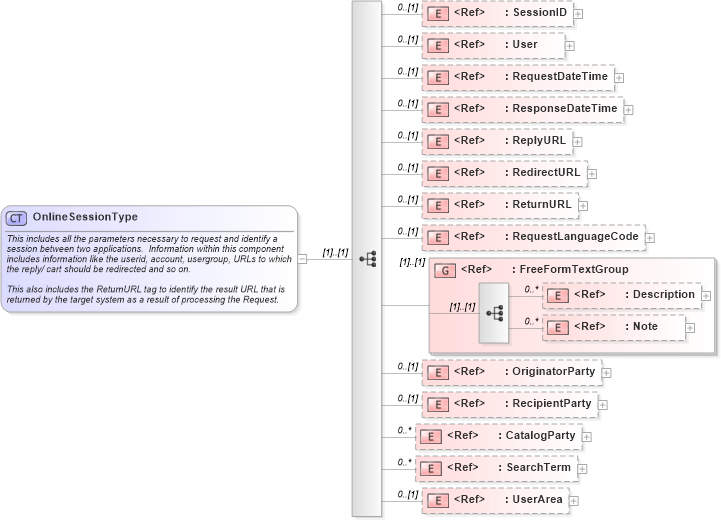
<xsd:complexType name="OnlineSessionType">
    <xsd:annotation>
        <xsd:documentation source="http://www.openapplications.org/oagis/9">This includes all the parameters necessary to request and identify a session between two applications.  Information within this component includes information like the userid, account, usergroup, URLs to which the reply/ cart should be redirected and so on.

This also includes the ReturnURL tag to identify the result URL that is returned by the target system as a result of processing the Request.</xsd:documentation>
    </xsd:annotation>
    <xsd:sequence>
        <xsd:element ref="SessionID" minOccurs="0">
            <xsd:annotation>
                <xsd:documentation source="http://www.openapplications.org/oagis/9">The SessionId uniquely identifies the session that makes the Request</xsd:documentation>
            </xsd:annotation>
        </xsd:element>
        <xsd:element ref="User" minOccurs="0" />
        <xsd:element ref="RequestDateTime" minOccurs="0">
            <xsd:annotation>
                <xsd:documentation source="http://www.openapplications.org/oagis/9">This is the DateTime at which the Request for the OnlineSession is initiated by the Requesting application</xsd:documentation>
            </xsd:annotation>
        </xsd:element>
        <xsd:element ref="ResponseDateTime" minOccurs="0">
            <xsd:annotation>
                <xsd:documentation source="http://www.openapplications.org/oagis/9">This is the DateTime at which the Response for the OnlineSession is generated by the Target application</xsd:documentation>
            </xsd:annotation>
        </xsd:element>
        <xsd:element ref="ReplyURL" minOccurs="0">
            <xsd:annotation>
                <xsd:documentation source="http://www.openapplications.org/oagis/9">The ReplyURL is used to specify a URL that can be used by the provider to post any information collected by the requester in the session. An example of usage of this is to post the contents of a cart created by a buying application user from an external catalog.</xsd:documentation>
            </xsd:annotation>
        </xsd:element>
        <xsd:element ref="RedirectURL" minOccurs="0">
            <xsd:annotation>
                <xsd:documentation source="http://www.openapplications.org/oagis/9">The RedirectURL can be used to indicate a URL to which the Requesting application can be re-directed once the session initiated by this connection is completed. The session completion event is not recorded in this transaction. </xsd:documentation>
            </xsd:annotation>
        </xsd:element>
        <xsd:element ref="ReturnURL" minOccurs="0">
            <xsd:annotation>
                <xsd:documentation source="http://www.openapplications.org/oagis/9">The ReturnURL element is specified in the Show ECatalogURL by the target application. It contains a URL reference to which the requesting application is pointed. This will not have a value in the Request (Get) Message</xsd:documentation>
            </xsd:annotation>
        </xsd:element>
        <xsd:element ref="RequestLanguageCode" minOccurs="0">
            <xsd:annotation>
                <xsd:documentation source="http://www.openapplications.org/oagis/9">The RequestLanguage element can be used by the requesting system to indicate the desired language of the catalog or application to which session will be initiated upon receipt of the Show URL transaction.  For instance, application A wishes to ‘punch out’ to external system B’s online Dutch-language catalog.  System B supports numerous languages, but will validate the value of the 'RequestLanguage' element and return the appropriate URL to direct application A to the Dutch site</xsd:documentation>
            </xsd:annotation>
        </xsd:element>
        <xsd:group ref="FreeFormTextGroup" />
        <xsd:element ref="OriginatorParty" minOccurs="0" />
        <xsd:element ref="RecipientParty" minOccurs="0" />
        <xsd:element ref="CatalogParty" minOccurs="0" maxOccurs="unbounded" />
        <xsd:element ref="SearchTerm" minOccurs="0" maxOccurs="unbounded" />
        <xsd:element ref="UserArea" minOccurs="0" />
    </xsd:sequence>
</xsd:complexType>
|
 XSD Schema Diagram: