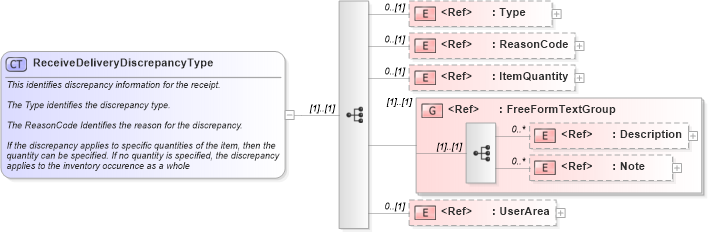
<xsd:complexType name="ReceiveDeliveryDiscrepancyType">
    <xsd:annotation>
        <xsd:documentation source="http://www.openapplications.org/oagis/9">This identifies discrepancy information for the receipt.

The Type identifies the discrepancy type.

The ReasonCode Identifies the reason for the discrepancy.

If the discrepancy applies to specific quantities of the item, then the quantity can be specified. If no quantity is specified, the discrepancy applies to the inventory occurence as a whole</xsd:documentation>
    </xsd:annotation>
    <xsd:sequence>
        <xsd:element ref="Type" minOccurs="0">
            <xsd:annotation>
                <xsd:documentation source="http://www.openapplications.org/oagis/9">This is an exception classification that codifies the general problem encountered during a business process, such as receiving goods</xsd:documentation>
            </xsd:annotation>
        </xsd:element>
        <xsd:element ref="ReasonCode" minOccurs="0">
            <xsd:annotation>
                <xsd:documentation source="http://www.openapplications.org/oagis/9">Identifies the reason for the discrepancy.</xsd:documentation>
            </xsd:annotation>
        </xsd:element>
        <xsd:element ref="ItemQuantity" minOccurs="0">
            <xsd:annotation>
                <xsd:documentation source="http://www.openapplications.org/oagis/9">If the discrepancy applies to specific quantities of the item, then the quantity can be specified. If no quantity is specified, the discrepancy applies to the inventory occurence as a whole</xsd:documentation>
            </xsd:annotation>
        </xsd:element>
        <xsd:group ref="FreeFormTextGroup" />
        <xsd:element ref="UserArea" minOccurs="0" />
    </xsd:sequence>
</xsd:complexType>
|
 XSD Schema Diagram: