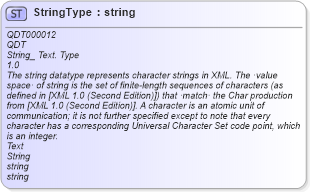
<xsd:simpleType name="StringType">
    <xsd:annotation>
        <xsd:documentation xml:lang="en">
            <ccts:UniqueID xmlns:ccts="urn:un:unece:uncefact:documentation:1.1">QDT000012</ccts:UniqueID>
            <ccts:CategoryCode xmlns:ccts="urn:un:unece:uncefact:documentation:1.1">QDT</ccts:CategoryCode>
            <ccts:DictionaryEntryName xmlns:ccts="urn:un:unece:uncefact:documentation:1.1">String_ Text. Type</ccts:DictionaryEntryName>
            <ccts:VersionID xmlns:ccts="urn:un:unece:uncefact:documentation:1.1">1.0</ccts:VersionID>
            <ccts:DefinitionText xmlns:ccts="urn:un:unece:uncefact:documentation:1.1">The string datatype represents character strings in XML. The ·value space· of string is the set of finite-length sequences of characters (as defined in [XML 1.0 (Second Edition)]) that ·match· the Char production from [XML 1.0 (Second Edition)]. A character is an atomic unit of communication; it is not further specified except to note that every character has a corresponding Universal Character Set code point, which is an integer.</ccts:DefinitionText>
            <ccts:RepresentationTermName xmlns:ccts="urn:un:unece:uncefact:documentation:1.1">Text</ccts:RepresentationTermName>
            <ccts:QualifierTerm xmlns:ccts="urn:un:unece:uncefact:documentation:1.1">String</ccts:QualifierTerm>
            <ccts:PrimitiveType xmlns:ccts="urn:un:unece:uncefact:documentation:1.1">string</ccts:PrimitiveType>
            <xsd:BuiltInType>string</xsd:BuiltInType>
        </xsd:documentation>
    </xsd:annotation>
    <xsd:restriction base="xsd:string" />
</xsd:simpleType>
|
 XSD Schema Diagram: