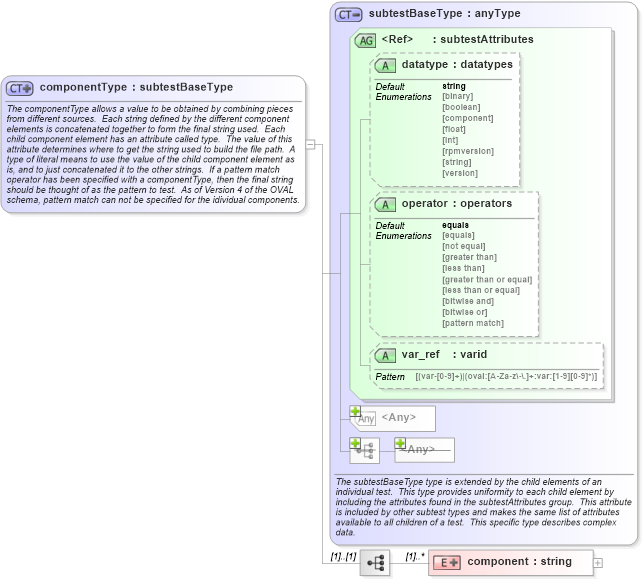
<xsd:complexType name="componentType">
    <xsd:annotation>
        <xsd:documentation>The componentType allows a value to be obtained by combining pieces from different sources.  Each string defined by the different component elements is concatenated together to form the final string used.  Each child component element has an attribute called type.  The value of this attribute determines where to get the string used to build the file path.  A type of literal means to use the value of the child component element as is, and to just concatenated it to the other strings.  If a pattern match operator has been specified with a componentType, then the final string should be thought of as the pattern to test.  As of Version 4 of the OVAL schema, pattern match can not be specified for the idividual components.</xsd:documentation>
        <xsd:appinfo>
            <extends>oval:subtestBaseType</extends>
            <attributes>(includes oval:subtestAttributes)</attributes>
            <content>none</content>
            <child_elements>component</child_elements>
        </xsd:appinfo>
    </xsd:annotation>
    <xsd:complexContent>
        <xsd:extension base="oval:subtestBaseType">
            <xsd:sequence>
                <xsd:element name="component" maxOccurs="unbounded">
                    <xsd:complexType>
                        <xsd:simpleContent>
                            <xsd:extension base="xsd:string">
                                <xsd:attribute name="type" use="required">
                                    <xsd:simpleType>
                                        <xsd:restriction base="xsd:string">
                                            <xsd:enumeration value="environment_variable" />
                                            <xsd:enumeration value="group_homedirs" />
                                            <xsd:enumeration value="literal" />
                                            <xsd:enumeration value="user_homedirs" />
                                        </xsd:restriction>
                                    </xsd:simpleType>
                                </xsd:attribute>
                            </xsd:extension>
                        </xsd:simpleContent>
                    </xsd:complexType>
                </xsd:element>
            </xsd:sequence>
        </xsd:extension>
    </xsd:complexContent>
</xsd:complexType>
|
 XSD Schema Diagram: