<xsd:element name="configuration">
    <xsd:annotation>
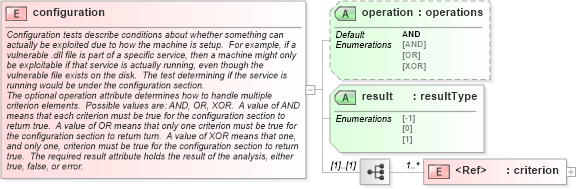
        <xsd:documentation>Configuration tests describe conditions about whether something can actually be exploited due to how the machine is setup.  For example, if a vulnerable .dll file is part of a specific service, then a machine might only be exploitable if that service is actually running, even though the vulnerable file exists on the disk.  The test determining if the service is running would be under the configuration section.</xsd:documentation>
        <xsd:documentation>The optional operation attribute determines how to handle multiple criterion elements.  Possible values are: AND, OR, XOR.  A value of AND means that each criterion must be true for the configuration section to return true.  A value of OR means that only one criterion must be true for the configuration section to return turn.  A value of XOR means that one, and only one, criterion must be true for the configuration section to return true.  The required result attribute holds the result of the analysis, either true, false, or error.</xsd:documentation>
        <xsd:appinfo>
            <cardinality>0-1</cardinality>
            <attributes>operation</attributes>
            <content>none</content>
            <parent_elements>criteria</parent_elements>
            <child_elements>criterion</child_elements>
        </xsd:appinfo>
    </xsd:annotation>
    <xsd:complexType>
        <xsd:sequence>
            <xsd:element ref="oval_results:criterion" minOccurs="1" maxOccurs="unbounded" />
        </xsd:sequence>
        <xsd:attribute name="operation" type="oval_results:operations" use="optional" default="AND" />
        <xsd:attribute name="result" type="oval_results:resultType" use="required" />
    </xsd:complexType>
</xsd:element>
|
 XSD Schema Diagram: