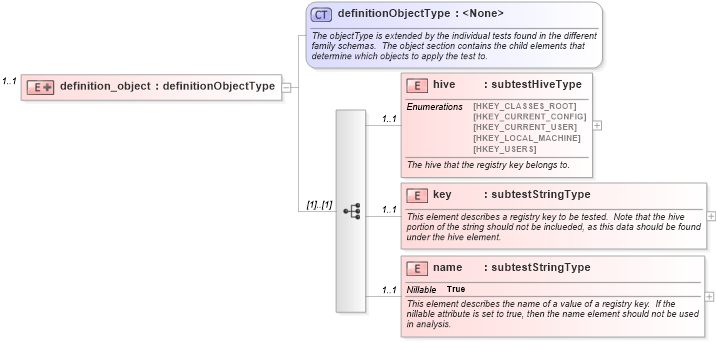
<xsd:element name="definition_object" minOccurs="1" maxOccurs="1">
    <xsd:complexType>
        <xsd:complexContent>
            <xsd:extension base="oval_results:definitionObjectType">
                <xsd:sequence>
                    <xsd:element name="hive" type="windows:subtestHiveType" minOccurs="1" maxOccurs="1">
                        <xsd:annotation>
                            <xsd:documentation>The hive that the registry key belongs to.</xsd:documentation>
                            <xsd:appinfo>
                                <parent_test>Registry Test</parent_test>
                                <cardinality>1</cardinality>
                                <content>string</content>
                                <valid_datatypes>string</valid_datatypes>
                                <valid_operators>equals, not equal</valid_operators>
                            </xsd:appinfo>
                        </xsd:annotation>
                    </xsd:element>
                    <xsd:element name="key" type="oval_results:subtestStringType" minOccurs="1" maxOccurs="1">
                        <xsd:annotation>
                            <xsd:documentation>This element describes a registry key to be tested.  Note that the hive portion of the string should not be inclueded, as this data should be found under the hive element.</xsd:documentation>
                            <xsd:appinfo>
                                <parent_test>Registry Test</parent_test>
                                <cardinality>1</cardinality>
                                <content>string</content>
                                <valid_datatypes>string</valid_datatypes>
                                <valid_operators>equals, not equal, pattern match</valid_operators>
                            </xsd:appinfo>
                        </xsd:annotation>
                    </xsd:element>
                    <xsd:element name="name" type="oval_results:subtestStringType" minOccurs="1" maxOccurs="1" nillable="true">
                        <xsd:annotation>
                            <xsd:documentation>This element describes the name of a value of a registry key.  If the nillable attribute is set to true, then the name element should not be used in analysis.</xsd:documentation>
                            <xsd:appinfo>
                                <parent_test>Registry Test</parent_test>
                                <cardinality>1</cardinality>
                                <content>string</content>
                                <valid_datatypes>string</valid_datatypes>
                                <valid_operators>equals, not equal, pattern match</valid_operators>
                            </xsd:appinfo>
                        </xsd:annotation>
                    </xsd:element>
                </xsd:sequence>
            </xsd:extension>
        </xsd:complexContent>
    </xsd:complexType>
</xsd:element>
|
 XSD Schema Diagram: