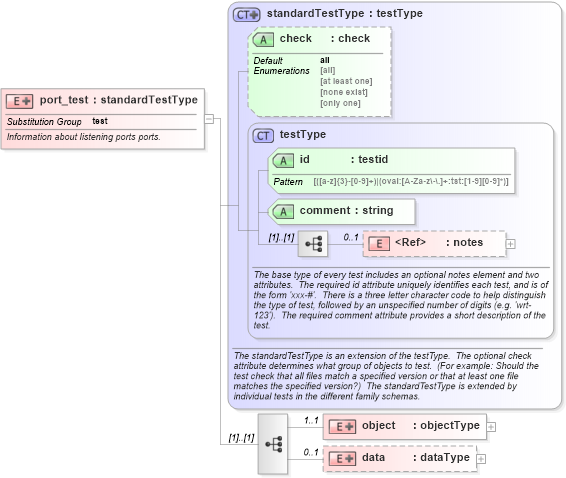
<xsd:element name="port_test" substitutionGroup="oval:test">
    <xsd:annotation>
        <xsd:documentation>Information about listening ports ports.</xsd:documentation>
        <xsd:appinfo>
            <test_name>Port Test</test_name>
            <extends>standardTestType</extends>
            <valid_sections>notes, object, data</valid_sections>
            <example>
                <port_test id="wqt-0" check="all" comment="TCP port 443 is open for listening by the process with an id of 3796" xmlns="http://oval.mitre.org/XMLSchema/oval#windows">
                    <oval:notes xmlns:oval="http://oval.mitre.org/XMLSchema/oval">
                        <oval:note>This is an example test written under version 4 of the OVAL schema.  It is meant to give a short overview of the test and might not contain every possible child element.</oval:note>
                    </oval:notes>
                    <object>
                        <local_address operator="pattern match">^.*$</local_address>
                        <local_port datatype="int">443</local_port>
                        <protocol>TCP</protocol>
                    </object>
                    <data>
                        <pid datatype="int">3796</pid>
                    </data>
                </port_test>
            </example>
        </xsd:appinfo>
    </xsd:annotation>
    <xsd:complexType>
        <xsd:complexContent>
            <xsd:extension base="oval:standardTestType">
                <xsd:sequence>
                    <xsd:element name="object" minOccurs="1" maxOccurs="1">
                        <xsd:complexType>
                            <xsd:complexContent>
                                <xsd:extension base="oval:objectType">
                                    <xsd:sequence>
                                        <xsd:element name="local_address" type="oval:subtestStringType" minOccurs="1" maxOccurs="1">
                                            <xsd:annotation>
                                                <xsd:documentation>This element specifies the local IP address the listening port is bound to.</xsd:documentation>
                                                <xsd:appinfo>
                                                    <parent_test>Port Test</parent_test>
                                                    <cardinality>1</cardinality>
                                                    <content>string</content>
                                                    <valid_datatypes>string</valid_datatypes>
                                                    <valid_operators>equals, not equal, pattern match</valid_operators>
                                                </xsd:appinfo>
                                            </xsd:annotation>
                                        </xsd:element>
                                        <xsd:element name="local_port" type="oval:subtestIntType" minOccurs="1" maxOccurs="1">
                                            <xsd:annotation>
                                                <xsd:documentation>This element specifies the number assigned to the local listening port.</xsd:documentation>
                                                <xsd:appinfo>
                                                    <parent_test>Port Test</parent_test>
                                                    <cardinality>1</cardinality>
                                                    <content>integer</content>
                                                    <valid_datatypes>integer</valid_datatypes>
                                                    <valid_operators>equals, not equal, greater than, less than, greater than or equal, less than or equal</valid_operators>
                                                </xsd:appinfo>
                                            </xsd:annotation>
                                        </xsd:element>
                                        <xsd:element name="protocol" minOccurs="1" maxOccurs="1">
                                            <xsd:annotation>
                                                <xsd:documentation>This element specifies the type of listening port.  It is restricted to either TCP or UDP.</xsd:documentation>
                                                <xsd:appinfo>
                                                    <parent_test>Port Test</parent_test>
                                                    <cardinality>1</cardinality>
                                                    <content>string</content>
                                                    <valid_datatypes>string</valid_datatypes>
                                                    <valid_operators>equals, not equal</valid_operators>
                                                </xsd:appinfo>
                                            </xsd:annotation>
                                            <xsd:complexType>
                                                <xsd:simpleContent>
                                                    <xsd:restriction base="oval:subtestStringType">
                                                        <xsd:enumeration value="TCP" />
                                                        <xsd:enumeration value="UDP" />
                                                    </xsd:restriction>
                                                </xsd:simpleContent>
                                            </xsd:complexType>
                                        </xsd:element>
                                    </xsd:sequence>
                                </xsd:extension>
                            </xsd:complexContent>
                        </xsd:complexType>
                    </xsd:element>
                    <xsd:element name="data" minOccurs="0" maxOccurs="1">
                        <xsd:complexType>
                            <xsd:complexContent>
                                <xsd:extension base="oval:dataType">
                                    <xsd:sequence>
                                        <xsd:element name="pid" type="oval:subtestIntType" minOccurs="0" maxOccurs="1">
                                            <xsd:annotation>
                                                <xsd:documentation>The id given to the process that is associated with the specified listening port.</xsd:documentation>
                                                <xsd:appinfo>
                                                    <parent_test>Port Test</parent_test>
                                                    <cardinality>0-1</cardinality>
                                                    <content>integer</content>
                                                    <valid_datatypes>integer</valid_datatypes>
                                                    <valid_operators>equals, not equal, greater than, less than, greater than or equal, less than or equal</valid_operators>
                                                </xsd:appinfo>
                                            </xsd:annotation>
                                        </xsd:element>
                                    </xsd:sequence>
                                </xsd:extension>
                            </xsd:complexContent>
                        </xsd:complexType>
                    </xsd:element>
                </xsd:sequence>
            </xsd:extension>
        </xsd:complexContent>
    </xsd:complexType>
</xsd:element>
|
 XSD Schema Diagram: