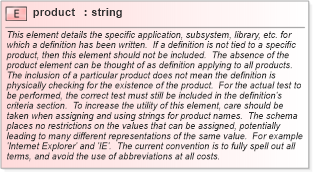
<xsd:element name="product" type="xsd:string">
    <xsd:annotation>
        <xsd:documentation>This element details the specific application, subsystem, library, etc. for which a definition has been written.  If a definition is not tied to a specific product, then this element should not be included.  The absence of the product element can be thought of as definition applying to all products.  The inclusion of a particular product does not mean the definition is physically checking for the existence of the product.  For the actual test to be performed, the correct test must still be included in the definition's criteria section.  To increase the utility of this element, care should be taken when assigning and using strings for product names.  The schema places no restrictions on the values that can be assigned, potentially leading to many different representations of the same value.  For example 'Internet Explorer' and 'IE'.  The current convention is to fully spell out all terms, and avoid the use of abbreviations at all costs.</xsd:documentation>
        <xsd:appinfo>
            <cardinality>0-n</cardinality>
            <attributes>none</attributes>
            <content>string</content>
            <parent_elements>affected</parent_elements>
            <child_elements>none</child_elements>
        </xsd:appinfo>
    </xsd:annotation>
</xsd:element>
|
 XSD Schema Diagram: