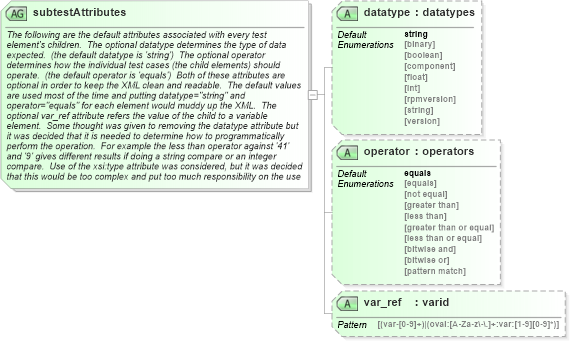
<xsd:attributeGroup name="subtestAttributes">
    <xsd:annotation>
        <xsd:documentation>The following are the default attributes associated with every test element's children.  The optional datatype determines the type of data expected.  (the default datatype is 'string')  The optional operator determines how the individual test cases (the child elements) should operate.  (the default operator is 'equals')  Both of these attributes are optional in order to keep the XML clean and readable.  The default values are used most of the time and putting datatype="string" and operator="equals" for each element would muddy up the XML.  The optional var_ref attribute refers the value of the child to a variable element.  Some thought was given to removing the datatype attribute but it was decided that it is needed to determine how to programmatically perform the operation.  For example the less than operator against '41' and '9' gives different results if doing a string compare or an integer compare.  Use of the xsi:type attribute was considered, but it was decided that this would be too complex and put too much responsibility on the user to chose the correct type for a given subtest element.</xsd:documentation>
        <xsd:appinfo>
            <attributes>[datatype], [operator], [var_ref]</attributes>
        </xsd:appinfo>
    </xsd:annotation>
    <xsd:attribute name="datatype" type="oval:datatypes" use="optional" default="string" />
    <xsd:attribute name="operator" type="oval:operators" use="optional" default="equals" />
    <xsd:attribute name="var_ref" type="oval:varid" use="optional" />
</xsd:attributeGroup>
|
 XSD Schema Diagram: