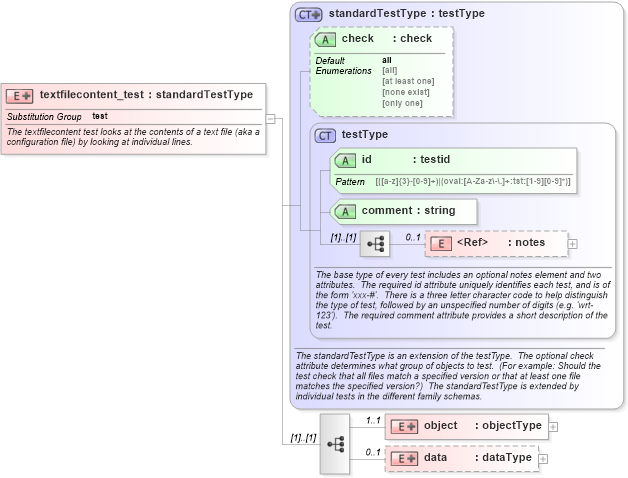
<xsd:element name="textfilecontent_test" substitutionGroup="oval:test">
    <xsd:annotation>
        <xsd:documentation>The textfilecontent test looks at the contents of a text file (aka a configuration file) by looking at individual lines.</xsd:documentation>
        <xsd:appinfo>
            <test_name>Text File Content Test</test_name>
            <extends>standardTestType</extends>
            <valid_sections>notes, object, data</valid_sections>
            <example>
                <textfilecontent_test id="tft-0" check="all" comment="the enable parameter in helpctr.txt is set to true" xmlns="http://oval.mitre.org/XMLSchema/oval#independent">
                    <oval:notes xmlns:oval="http://oval.mitre.org/XMLSchema/oval">
                        <oval:note>This is an example test.  It is meant to give a short overview of the test and might not contain every possible child element.</oval:note>
                    </oval:notes>
                    <object>
                        <path>
                            <component type="registry_value">HKEY_LOCAL_MACHINE\SOFTWARE\Microsoft\Windows NT\CurrentVersion\SystemRoot</component>
                            <component type="literal">\system32\helpctr.txt</component>
                        </path>
                        <line operator="pattern match">enable = (true|false)</line>
                    </object>
                    <data operation="AND">
                        <subexpression operator="equals">true</subexpression>
                    </data>
                </textfilecontent_test>
            </example>
        </xsd:appinfo>
    </xsd:annotation>
    <xsd:complexType>
        <xsd:complexContent>
            <xsd:extension base="oval:standardTestType">
                <xsd:sequence>
                    <xsd:element name="object" minOccurs="1" maxOccurs="1">
                        <xsd:complexType>
                            <xsd:complexContent>
                                <xsd:extension base="oval:objectType">
                                    <xsd:sequence>
                                        <xsd:element name="path" type="independent:componentType" minOccurs="1" maxOccurs="1">
                                            <xsd:annotation>
                                                <xsd:documentation>Specifies the absolute path to a file on the machine.  This path can be created from multiple components that are added together.  When a pattern match operator is used, the corresponding regular expression is matched against the set of absolute path strings.  These string would not include the '.' and '..' notations.  This means that a '.*' component of a regular expression will not only match all files in the specified directories, but all subdirectories, their subdirectories, etc.</xsd:documentation>
                                                <xsd:appinfo>
                                                    <parent_test>Text File Content Test</parent_test>
                                                    <cardinality>1</cardinality>
                                                    <content>none</content>
                                                    <valid_datatypes>component</valid_datatypes>
                                                    <valid_operators>equals, not equal, pattern match</valid_operators>
                                                </xsd:appinfo>
                                            </xsd:annotation>
                                        </xsd:element>
                                        <xsd:element name="line" type="oval:subtestStringType" minOccurs="1" maxOccurs="1" nillable="true">
                                            <xsd:annotation>
                                                <xsd:documentation>The line element represents a line in the file and is represented using a regular expression.</xsd:documentation>
                                                <xsd:appinfo>
                                                    <parent_test>Text File Content Test</parent_test>
                                                    <cardinality>1</cardinality>
                                                    <content>string</content>
                                                    <valid_datatypes>string</valid_datatypes>
                                                    <valid_operators>pattern match</valid_operators>
                                                </xsd:appinfo>
                                            </xsd:annotation>
                                        </xsd:element>
                                    </xsd:sequence>
                                </xsd:extension>
                            </xsd:complexContent>
                        </xsd:complexType>
                    </xsd:element>
                    <xsd:element name="data" minOccurs="0" maxOccurs="1">
                        <xsd:complexType>
                            <xsd:complexContent>
                                <xsd:extension base="oval:dataType">
                                    <xsd:sequence>
                                        <xsd:element name="subexpression" type="oval:subtestStringType" minOccurs="0" maxOccurs="unbounded">
                                            <xsd:annotation>
                                                <xsd:documentation>Each subexpression in the regular expression of the line element is then tested against the value specified in the subexpression element.</xsd:documentation>
                                                <xsd:appinfo>
                                                    <parent_test>Text File Content Test</parent_test>
                                                    <cardinality>0-n</cardinality>
                                                    <content>string</content>
                                                    <valid_datatypes>string</valid_datatypes>
                                                    <valid_operators>equals, not equal, pattern match</valid_operators>
                                                </xsd:appinfo>
                                            </xsd:annotation>
                                        </xsd:element>
                                    </xsd:sequence>
                                </xsd:extension>
                            </xsd:complexContent>
                        </xsd:complexType>
                    </xsd:element>
                </xsd:sequence>
            </xsd:extension>
        </xsd:complexContent>
    </xsd:complexType>
</xsd:element>
|
 XSD Schema Diagram: