<xsd:simpleType name="ClassEnumeration">
    <xsd:annotation>
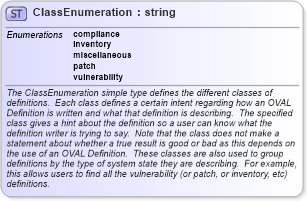
        <xsd:documentation>The ClassEnumeration simple type defines the different classes of definitions.  Each class defines a certain intent regarding how an OVAL Definition is written and what that definition is describing.  The specified class gives a hint about the definition so a user can know what the definition writer is trying to say.  Note that the class does not make a statement about whether a true result is good or bad as this depends on the use of an OVAL Definition.  These classes are also used to group definitions by the type of system state they are describing.  For example, this allows users to find all the vulnerability (or patch, or inventory, etc) definitions.</xsd:documentation>
    </xsd:annotation>
    <xsd:restriction base="xsd:string">
        <xsd:enumeration value="compliance">
            <xsd:annotation>
                <xsd:documentation>A compliance definition describes the state of a machine as it complies with a specific policy.  The intention is that a definition of this class will return true when the system is found to be compliant with the stated policy.  Another way of thinking about this is that a compliance definition is stating "the system is compliant if ...".</xsd:documentation>
            </xsd:annotation>
        </xsd:enumeration>
        <xsd:enumeration value="inventory">
            <xsd:annotation>
                <xsd:documentation>An inventory definition describes whether a specific piece of software is installed on the system.  The intention is that a definition of this class will return true when the specified software is found on the system.  Another way of thinking about this is that an inventory definition is stating "the software is installed if ...".</xsd:documentation>
            </xsd:annotation>
        </xsd:enumeration>
        <xsd:enumeration value="miscellaneous">
            <xsd:annotation>
                <xsd:documentation>The 'miscellaneous' class is used to identify definitions that do not fall into any of the other defined classes.</xsd:documentation>
            </xsd:annotation>
        </xsd:enumeration>
        <xsd:enumeration value="patch">
            <xsd:annotation>
                <xsd:documentation>A patch definition details the machine state of whether a patch executable should be installed.  The intention is that a definition of this class will return true when the specified patch is missing from the system.  Another way of thinking about this is that a patch definition is stating "the patch should be installed if ...".  Note that word SHOULD is intended to mean more than just CAN the patch executable be installed.  In other words, if a more recent patch is already installed then the specified patch might not need to be installed.</xsd:documentation>
            </xsd:annotation>
        </xsd:enumeration>
        <xsd:enumeration value="vulnerability">
            <xsd:annotation>
                <xsd:documentation>A vulnerability definition describes the conditions under which a machine is vulnerable.  The intention is that a definition of this class will return true when the system is found to be vulnerable with the stated issue.  Another way of thinking about this is that a vulnerability definition is stating "the system is vulnerable if ...".</xsd:documentation>
            </xsd:annotation>
        </xsd:enumeration>
    </xsd:restriction>
</xsd:simpleType>
|
 XSD Schema Diagram:
 Facets: