<xsd:complexType name="CriteriaType">
    <xsd:annotation>
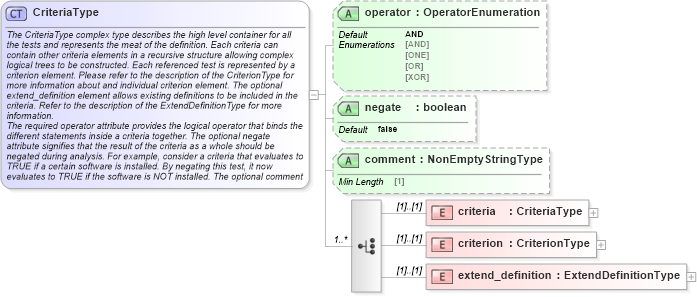
        <xsd:documentation>The CriteriaType complex type describes the high level container for all the tests and represents the meat of the definition. Each criteria can contain other criteria elements in a recursive structure allowing complex logical trees to be constructed. Each referenced test is represented by a criterion element. Please refer to the description of the CriterionType for more information about and individual criterion element. The optional extend_definition element allows existing definitions to be included in the criteria. Refer to the description of the ExtendDefinitionType for more information.</xsd:documentation>
        <xsd:documentation>The required operator attribute provides the logical operator that binds the different statements inside a criteria together. The optional negate attribute signifies that the result of the criteria as a whole should be negated during analysis. For example, consider a criteria that evaluates to TRUE if a certain software is installed. By negating this test, it now evaluates to TRUE if the software is NOT installed. The optional comment attribute provides a short description of the criteria.</xsd:documentation>
    </xsd:annotation>
    <xsd:choice minOccurs="1" maxOccurs="unbounded">
        <xsd:element name="criteria" type="oval-def:CriteriaType" />
        <xsd:element name="criterion" type="oval-def:CriterionType" />
        <xsd:element name="extend_definition" type="oval-def:ExtendDefinitionType" />
    </xsd:choice>
    <xsd:attribute name="operator" type="oval:OperatorEnumeration" use="optional" default="AND" />
    <xsd:attribute name="negate" type="xsd:boolean" use="optional" default="false" />
    <xsd:attribute name="comment" type="oval:NonEmptyStringType" use="optional" />
</xsd:complexType>
|
 XSD Schema Diagram: