<xsd:complexType name="CriteriaType">
    <xsd:annotation>
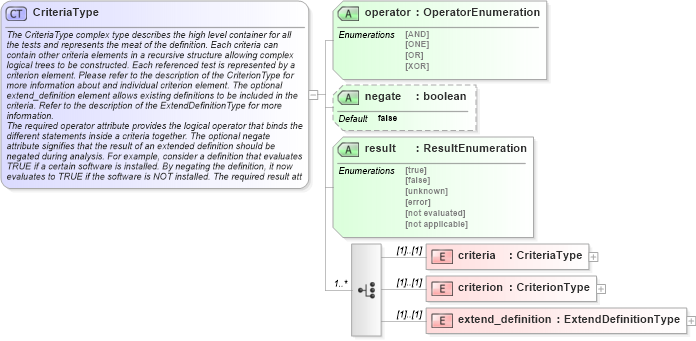
        <xsd:documentation>The CriteriaType complex type describes the high level container for all the tests and represents the meat of the definition. Each criteria can contain other criteria elements in a recursive structure allowing complex logical trees to be constructed. Each referenced test is represented by a criterion element. Please refer to the description of the CriterionType for more information about and individual criterion element. The optional extend_definition element allows existing definitions to be included in the criteria. Refer to the description of the ExtendDefinitionType for more information.</xsd:documentation>
        <xsd:documentation>The required operator attribute provides the logical operator that binds the different statements inside a criteria together. The optional negate attribute signifies that the result of an extended definition should be negated during analysis. For example, consider a definition that evaluates TRUE if a certain software is installed. By negating the definition, it now evaluates to TRUE if the software is NOT installed. The required result attribute holds the result of the evaluation of the criteria. Note that this would be after any negation operation has been applied. Please refer to the description of the resultEnumeration for details about the different result values.</xsd:documentation>
    </xsd:annotation>
    <xsd:choice minOccurs="1" maxOccurs="unbounded">
        <xsd:element name="criteria" type="oval-res:CriteriaType" />
        <xsd:element name="criterion" type="oval-res:CriterionType" />
        <xsd:element name="extend_definition" type="oval-res:ExtendDefinitionType" />
    </xsd:choice>
    <xsd:attribute name="operator" type="oval:OperatorEnumeration" use="required" />
    <xsd:attribute name="negate" type="xsd:boolean" use="optional" default="false" />
    <xsd:attribute name="result" type="oval-res:ResultEnumeration" use="required" />
</xsd:complexType>
|
 XSD Schema Diagram: