Definition Type: ComplexType
Name: CriterionType
Namespace: http://oval.mitre.org/XMLSchema/oval-results-5
Containing Schema: oval-results-schema.xsd
Abstract
Documentation:
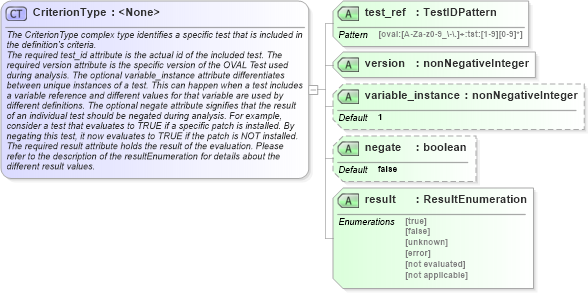
The CriterionType complex type identifies a specific test that is included in the definition's criteria. The required test_id attribute is the actual id of the included test. The required version attribute is the specific version of the OVAL Test used during analysis. The optional variable_instance attribute differentiates between unique instances of a test. This can happen when a test includes a variable reference and different values for that variable are used by different definitions. The optional negate attribute signifies that the result of an individual test should be negated during analysis. For example, consider a test that evaluates to TRUE if a specific patch is installed. By negating this test, it now evaluates to TRUE if the patch is NOT installed. The required result attribute holds the result of the evaluation. Please refer to the description of the resultEnumeration for details about the different result values.
Collapse XSD Schema Diagram:
Drilldown into result in schema oval-results-schema_xsd Drilldown into negate in schema oval-results-schema_xsd Drilldown into variable_instance in schema oval-results-schema_xsd Drilldown into version in schema oval-results-schema_xsd Drilldown into test_ref in schema oval-results-schema_xsdXSD Diagram of CriterionType in schema oval-results-schema_xsd (Open Vulnerability and Assessment Language (OVAL®))
Collapse XSD Schema Code:
<xsd:complexType name="CriterionType">
    <xsd:annotation>
        <xsd:documentation>The CriterionType complex type identifies a specific test that is included in the definition's criteria.</xsd:documentation>
        <xsd:documentation>The required test_id attribute is the actual id of the included test. The required version attribute is the specific version of the OVAL Test used during analysis. The optional variable_instance attribute differentiates between unique instances of a test. This can happen when a test includes a variable reference and different values for that variable are used by different definitions. The optional negate attribute signifies that the result of an individual test should be negated during analysis. For example, consider a test that evaluates to TRUE if a specific patch is installed. By negating this test, it now evaluates to TRUE if the patch is NOT installed. The required result attribute holds the result of the evaluation. Please refer to the description of the resultEnumeration for details about the different result values.</xsd:documentation>
    </xsd:annotation>
    <xsd:attribute name="test_ref" type="oval:TestIDPattern" use="required" />
    <xsd:attribute name="version" type="xsd:nonNegativeInteger" use="required" />
    <xsd:attribute name="variable_instance" type="xsd:nonNegativeInteger" use="optional" default="1" />
    <xsd:attribute name="negate" type="xsd:boolean" use="optional" default="false" />
    <xsd:attribute name="result" type="oval-res:ResultEnumeration" use="required" />
</xsd:complexType>
Collapse Child Attributes:
Name Type Default Value Use
test_ref oval-res:test_ref Required
version oval-res:version Required
variable_instance oval-res:variable_instance 1 Optional
negate oval-res:negate false Optional
result oval-res:result Required
Collapse Derivation Tree:
Collapse References:
oval-res:criterion