<xsd:simpleType name="DatatypeEnumeration">
    <xsd:annotation>
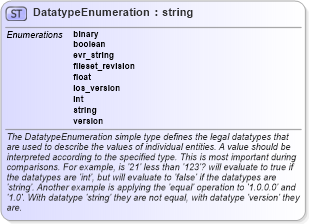
        <xsd:documentation>The DatatypeEnumeration simple type defines the legal datatypes that are used to describe the values of individual entities. A value should be interpreted according to the specified type. This is most important during comparisons. For example, is '21' less than '123'? will evaluate to true if the datatypes are 'int', but will evaluate to 'false' if the datatypes are 'string'. Another example is applying the 'equal' operation to '1.0.0.0' and '1.0'. With datatype 'string' they are not equal, with datatype 'version' they are.</xsd:documentation>
    </xsd:annotation>
    <xsd:restriction base="xsd:string">
        <xsd:enumeration value="binary">
            <xsd:annotation>
                <xsd:documentation>The binary datatype is used to represent data that is in raw (non-printable) form. Values should be hex strings. Expected operations within OVAL for binary values are 'equals' and 'not equal'.</xsd:documentation>
            </xsd:annotation>
        </xsd:enumeration>
        <xsd:enumeration value="boolean">
            <xsd:annotation>
                <xsd:documentation>The boolean datatype represents standard boolean data, either true or false. Expected operations within OVAL for boolean values are 'equals' and 'not equal'.</xsd:documentation>
            </xsd:annotation>
        </xsd:enumeration>
        <xsd:enumeration value="evr_string">
            <xsd:annotation>
                <xsd:documentation>The evr_string datatype represents the epoch, version, and release fields as a single version string. It has the form "EPOCH:VERSION-RELEASE". Comparisons involving this datatype should follow the algorithm of librpm's rpmvercmp() function. Expected operations within OVAL for evr_string values are 'equals', 'not equal', 'greater than', 'greater than or equal', 'less than', and 'less than or equal'.</xsd:documentation>
            </xsd:annotation>
        </xsd:enumeration>
        <xsd:enumeration value="fileset_revision">
            <xsd:annotation>
                <xsd:documentation>The fileset_revision datatype represents the version string related to filesets in HP-UX. An example would be 'A.03.61.00'. As far as implementing operations, right now there is a IP licensing issue being discussed on our ability to publicize the method to do this; however, the HP-UX team is willing to discuss how to implement this with anyone who would like to do it while we are waiting for the IP licensing issue to be resolved. Expected operations within OVAL for fileset_version values are 'equals', 'not equal', 'greater than', 'greater than or equal', 'less than', and 'less than or equal'.</xsd:documentation>
            </xsd:annotation>
        </xsd:enumeration>
        <xsd:enumeration value="float">
            <xsd:annotation>
                <xsd:documentation>The float datatype describes standard float data. Expected operations within OVAL for float values are 'equals', 'not equal', 'greater than', 'greater than or equal', 'less than', and 'less than or equal'.</xsd:documentation>
            </xsd:annotation>
        </xsd:enumeration>
        <xsd:enumeration value="ios_version">
            <xsd:annotation>
                <xsd:documentation>The ios_version datatype describes Cisco IOS Train strings. These are in essence version strings for IOS. Please refer to Cisco's IOS Reference Guide for information on how to compare different Trains as they follow a very specific pattern. Expected operations within OVAL for ios_version values are 'equals', 'not equal', 'greater than', 'greater than or equal', 'less than', and 'less than or equal'.</xsd:documentation>
            </xsd:annotation>
        </xsd:enumeration>
        <xsd:enumeration value="int">
            <xsd:annotation>
                <xsd:documentation>The int datatype describes standard integer data.  Note that this is based off the built-in xsd integer datatype with an infinite range.  Expected operations within OVAL for int values are 'equals', 'not equal', 'greater than', 'greater than or equal', 'less than', 'less than or equal', 'bitwise and', and 'bitwise or'.</xsd:documentation>
            </xsd:annotation>
        </xsd:enumeration>
        <xsd:enumeration value="string">
            <xsd:annotation>
                <xsd:documentation>The string datatype describes standard string data. Expected operations within OVAL for string values are 'equals', 'not equal', 'case insensitive equals', 'case insensitive not equal', 'pattern match'.</xsd:documentation>
            </xsd:annotation>
        </xsd:enumeration>
        <xsd:enumeration value="version">
            <xsd:annotation>
                <xsd:documentation>The version datatype represents a value that is a hierarchical list of non-negative integers separated by a single character delimiter. Expected operations within OVAL for version values are 'equals', 'not equal', 'greater than', 'greater than or equal', 'less than', and 'less than or equal'.</xsd:documentation>
                <xsd:documentation>For example '#.#.#' or '#-#-#-#' where the numbers to the left are more significant than the numbers to the right. When performing an 'equals' operation on a version datatype, you should first check the left most number for equality. If that fails, then the values are not equal. If it succeeds, then check the second left most number for equality. Continue checking the numbers from left to right until the last number has been checked. If, after testing all the previous numbers, the last number is equal then the two versions are equal. When performing other operations, such as 'less than', 'less than or equal', 'greater than, or 'greater than or equal', similar logic as above is used. Start with the left most number and move from left to right. For each number, check if it is less than the number you are testing against. If it is, then the version in question is less than the version you are testing against. If the number is equal, then move to check the next number to the right. For example, to test if 5.7.23 is less than or equal to 5.8.0 you first compare 5 to 5. They are equal so you move on to compare 7 to 8. 7 is less than 8 so the entire test succeeds and 5.7.23 is 'less than or equal' to 5.8.0. The difference between the 'less than' and 'less than or equal' operations is how the last number is handled. If the last number is reached, the check should use the given operation (either 'less than' and 'less than or equal') to test the number. For example, to test if 4.23.6 is greater than 4.23.6 you first compare 4 to 4. They are equal so you move on to compare 23 to 23. They are equal so you move on to compare 6 to 6. This is the last number in the version and since 6 is not greater than 6, the entire test fails and 4.23.6 is not greater than 4.23.6.</xsd:documentation>
                <xsd:documentation>Version strings with a different number of components shall be padded with zeros to make them the same size. For example, if the version strings '1.2.3' and '6.7.8.9' are being compared, then the short one should be padded to become '1.2.3.0'.</xsd:documentation>
            </xsd:annotation>
        </xsd:enumeration>
    </xsd:restriction>
</xsd:simpleType>
|
 XSD Schema Diagram:
 Facets: