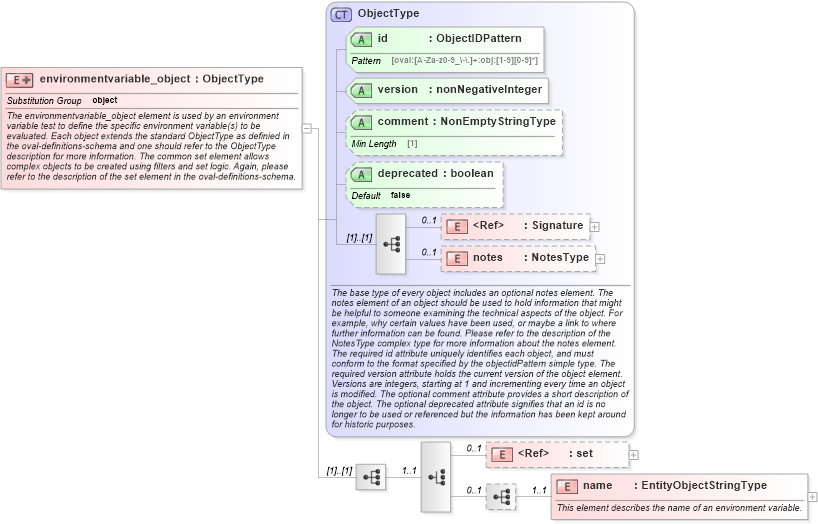
<xsd:element name="environmentvariable_object" substitutionGroup="oval-def:object">
    <xsd:annotation>
        <xsd:documentation>The environmentvariable_object element is used by an environment variable test to define the specific environment variable(s) to be evaluated. Each object extends the standard ObjectType as definied in the oval-definitions-schema and one should refer to the ObjectType description for more information. The common set element allows complex objects to be created using filters and set logic. Again, please refer to the description of the set element in the oval-definitions-schema.</xsd:documentation>
    </xsd:annotation>
    <xsd:complexType>
        <xsd:complexContent>
            <xsd:extension base="oval-def:ObjectType">
                <xsd:sequence>
                    <xsd:choice minOccurs="1" maxOccurs="1">
                        <xsd:element ref="oval-def:set" minOccurs="0" maxOccurs="1" />
                        <xsd:sequence minOccurs="0" maxOccurs="1">
                            <xsd:element name="name" type="oval-def:EntityObjectStringType" minOccurs="1" maxOccurs="1">
                                <xsd:annotation>
                                    <xsd:documentation>This element describes the name of an environment variable.</xsd:documentation>
                                    <xsd:appinfo>
                                        <sch:pattern id="envobjname" xmlns:sch="http://purl.oclc.org/dsdl/schematron">
                                            <sch:rule context="ind-def:environmentvariable_object/ind-def:name">
                                                <sch:assert test="not(@datatype) or @datatype='string'">
                                                    <sch:value-of select="../@id" /> - datatype attribute for the name entity of an environmentvariable_object should be 'string'</sch:assert>
                                            </sch:rule>
                                        </sch:pattern>
                                    </xsd:appinfo>
                                </xsd:annotation>
                            </xsd:element>
                        </xsd:sequence>
                    </xsd:choice>
                </xsd:sequence>
            </xsd:extension>
        </xsd:complexContent>
    </xsd:complexType>
</xsd:element>
|
 XSD Schema Diagram: